On this page
Tissue-Repair & Regenerative Peptides: A Research Overview
Several research peptides are grouped under the heading of "tissue repair" because preclinical studies examine their activity in wound-healing, angiogenesis, and extracellular-matrix models. The grouping is convenient but can mislead, because the compounds in this class act through entirely distinct mechanisms. This overview maps the class, what each compound is studied for, and where the mechanisms diverge, all within a laboratory-research frame.
Three single compounds anchor the class, BPC-157, TB-500, and GHK-Cu, alongside multi-peptide research blends that combine them. Each has a separate body of preclinical literature, and each engages a different target. Knowing those differences is what turns "they all help tissue heal," a claim research does not support as stated, into an accurate picture of what the studies actually measure.
What are tissue-repair peptides?#
In a research context, "tissue-repair peptides" describes peptides whose preclinical studies investigate processes associated with repair and regeneration: angiogenesis (new blood-vessel formation), fibroblast and keratinocyte activity, cell migration, collagen and extracellular-matrix turnover, and modulation of inflammatory signaling. The term names the research areas these compounds appear in, not an established therapeutic effect. Most of the published work is preclinical, conducted in cell culture and animal models, and it does not establish human use.
Which peptides make up the tissue-repair class?#
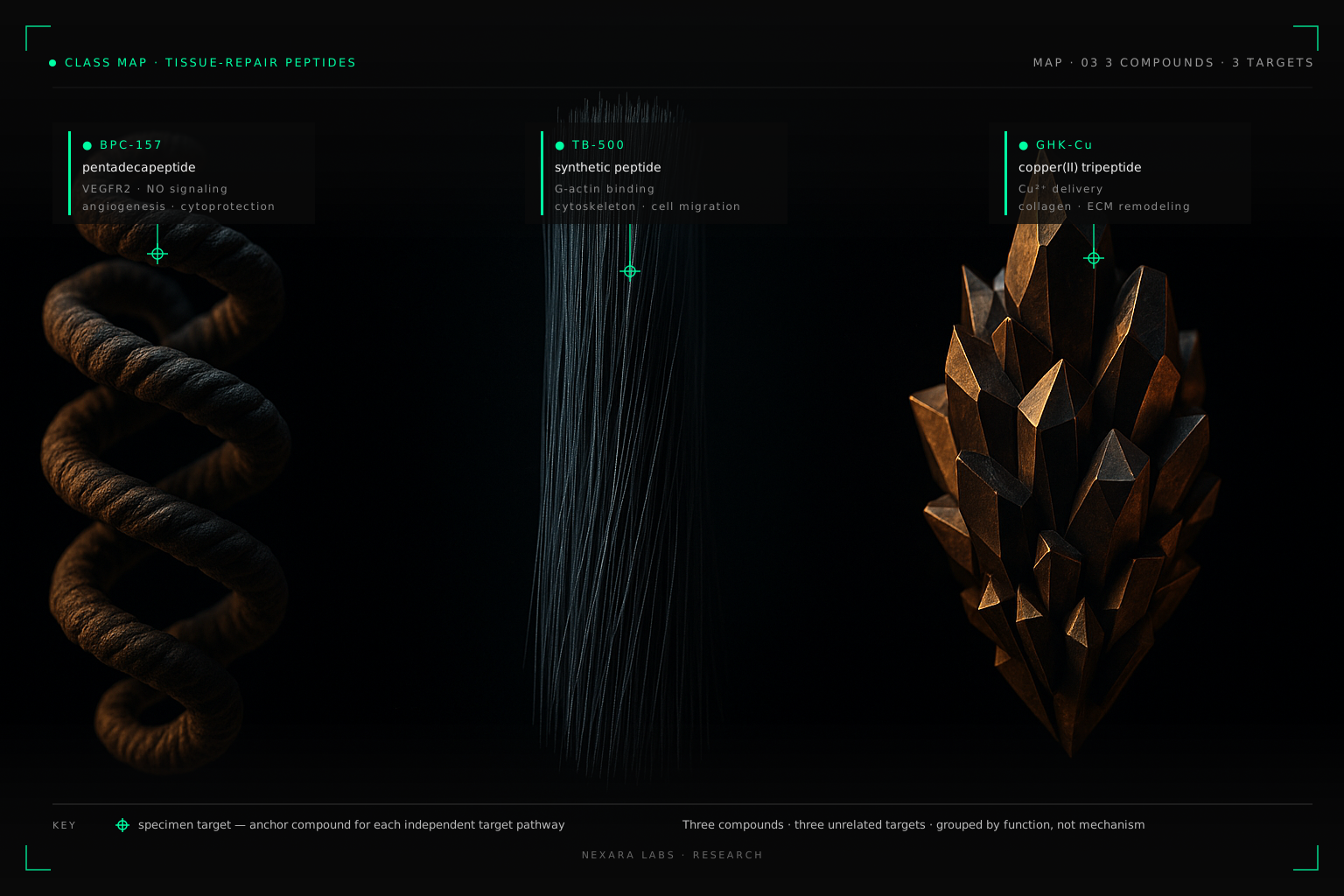
The class divides into single compounds and the blends built from them. The table below summarizes each single compound by origin, the molecular target the literature attributes to it, and the research areas it appears in. The targets share no common pathway, so the grouping is functional rather than mechanistic.
| Compound | Class & origin | Reported molecular target | What the literature studies |
|---|---|---|---|
| BPC-157 | 15-amino-acid sequence derived from a protein in gastric juice; first characterized 1993 (Sikiric, Univ. Zagreb) | Angiogenic signaling (VEGFR2) and the nitric-oxide system; cytoprotection | Tendon, ligament, gut, vascular, and CNS repair models |
| TB-500 | Synthetic peptide based on the actin-binding region of thymosin β4 (UniProt P62328) | G-actin sequestration; actin-cytoskeleton dynamics | Cell migration, angiogenesis, and wound-closure models |
| GHK-Cu | Copper(II) complex of the tripeptide glycyl-L-histidyl-L-lysine; isolated from human plasma in 1973 (Pickart) | Copper-dependent gene modulation; ECM and collagen signaling | Skin regeneration, collagen synthesis, and antioxidant pathways |
BPC-157#
BPC-157 is a stable pentadecapeptide (15 amino acids) whose sequence corresponds to a fragment of a protein found in human gastric juice. The bulk of its preclinical record, most of it from a single group at the University of Zagreb, examines cytoprotection and angiogenic signaling, with reported activity at the VEGFR2 receptor and the nitric-oxide pathway, across tendon, ligament, gut, and vascular models. Its identity and research context are covered in depth in the BPC-157 compound profile.
TB-500#
TB-500 is a synthetic peptide based on the active, actin-binding region of thymosin β4, the principal G-actin–sequestering protein in many cell types. By regulating the pool of monomeric actin, thymosin β4 influences the cytoskeletal remodeling that underlies cell migration, so the TB-500 literature centers on migration, angiogenesis, and wound-closure models rather than the cytoprotective signaling associated with BPC-157. Detail is in the TB-500 compound profile.
GHK-Cu#
GHK-Cu is the copper(II) complex of the tripeptide glycyl-L-histidyl-L-lysine, first isolated from human plasma in 1973. Unlike the two larger peptides, its activity is copper-dependent: the research literature attributes broad gene-modulating effects to the GHK–copper complex, with study areas spanning collagen synthesis, extracellular-matrix remodeling, and antioxidant pathways. It is the only member of the class that carries copper. Its research context is covered in the GHK-Cu compound profile.
How do BPC-157 and TB-500 differ?#
This is the most common question about the class, and the short answer is that the two act on unrelated targets. BPC-157 is studied for cytoprotective and angiogenic signaling (VEGFR2, the nitric-oxide system); TB-500 is studied for actin-cytoskeleton regulation that drives cell migration. Because the mechanisms do not overlap, the preclinical literature often examines them in combination, which is the basis for the research blends below. The full side-by-side breakdown lives in the dedicated comparison, BPC-157 vs TB-500.
What are recovery blends?#
Because the single compounds engage different pathways, some research formulations combine them into multi-peptide blends. The Wolverine blend pairs BPC-157 with TB-500, and the KLOW blend combines GHK-Cu, BPC-157, TB-500, and KPV — a tripeptide studied in inflammatory-signaling research — into a four-compound formulation. In a research setting these are studied for the combined activity of their separate components, not for any additive benefit claim. The rationale is mechanistic coverage across the angiogenic, cytoskeletal, matrix, and inflammatory pathways the individual compounds address.
How are tissue-repair peptides handled in the lab?#
All of these compounds ship as lyophilized powder and must be reconstituted before use. Handling matches the rest of the peptide catalog: the reconstitution and lyophilization primer covers solvent choice and aggregation risk, and the cold-chain article covers shipping and storage stability. Purity is the other variable that matters before any study, which is why what ≥99% purity actually means explains why the threshold is method-anchored. For research at the organelle level rather than systemic tissue, the mitochondrial-targeted peptide class covers a separate set of compounds with a different mechanistic angle.
How Nexara handles this class#
Each peptide in this class is specified at ≥99% purity and labeled with a batch identifier for shipment traceability. Independent third-party COA delivery is currently paused while the testing program transitions to a new laboratory partner; the research compliance page documents the operational posture during this period. All compounds are sold strictly for laboratory research use.
Frequently asked
- What are tissue-repair peptides?
- It is a research grouping for peptides whose preclinical studies investigate repair- and regeneration-associated processes: angiogenesis, cell migration, collagen and extracellular-matrix turnover, and inflammatory-signal modulation. The main single compounds are BPC-157, TB-500, and GHK-Cu. The label describes the research areas these compounds appear in, not an established therapeutic effect, and most published work is cell-culture or animal-model research.
- What is the difference between BPC-157 and TB-500?
- They act on unrelated targets. BPC-157 is a 15-amino-acid gastric-juice-derived peptide studied for cytoprotective and angiogenic signaling (VEGFR2, the nitric-oxide system). TB-500 is a synthetic fragment of thymosin β4 studied for actin-cytoskeleton regulation that drives cell migration. Because the mechanisms do not overlap, the preclinical literature often examines them together rather than as alternatives.
- Is GHK-Cu a peptide?
- GHK-Cu is the copper(II) complex of the tripeptide glycyl-L-histidyl-L-lysine (GHK). It is the smallest member of the tissue-repair research class and the only copper carrier among them. It was first isolated from human plasma in 1973, and its reported activity is copper-dependent, which distinguishes it mechanistically from BPC-157 and TB-500.
- What are the Wolverine and KLOW blends?
- They are multi-peptide research blends. The Wolverine blend combines BPC-157 and TB-500; the KLOW blend combines GHK-Cu, BPC-157, TB-500, and KPV. In research they are studied for the combined activity of their separate components, which target different pathways (angiogenic, cytoskeletal, and matrix), rather than for any additive-benefit claim.
- How should tissue-repair peptides be stored?
- They ship as lyophilized powder and should be kept according to standard peptide cold-chain practice: lyophilized material is comparatively stable, while reconstituted solution is far less so and is typically refrigerated and used within a defined window. The reconstitution primer and cold-chain articles cover solvent selection, aggregation risk, and storage stability in detail.
Sources and further reading#
- Sikiric et al., Stable Gastric Pentadecapeptide BPC 157 — cytoprotection and organoprotection review (PMC7096228): foundational review of the BPC-157 preclinical record from the originating research group.
- BPC 157 pleiotropic beneficial activity review (PMC11053547): survey of reported BPC-157 activity across organ systems and signaling pathways.
- Structural basis of thymosin-β4/profilin exchange in actin polymerization, PNAS (PMC4217450): structural account of how thymosin β4, the parent of TB-500, sequesters G-actin.
- Thymosin beta-4, UniProt P62328: the canonical sequence and annotation entry for the parent protein of TB-500.
- Pickart & Margolina, GHK and gene modulation in skin regeneration (PMC4508379): review of the copper tripeptide GHK as a modulator of multiple cellular pathways.
- Actin-sequestering ability of thymosin β4 and its fragments (PMID 8471179): primary characterization of the actin-binding behavior relevant to TB-500.
Last updated: 2026-07-14
Continue your research
- Deep dive
BPC-157 vs TB-500: How Two Tissue-Repair Peptides Differ
BPC-157 and TB-500 are studied side by side but act on unrelated targets. A research comparison of their mechanisms, study areas, and why the literature examines them together.
- Next foundational
Cold-Chain Logistics for Research Peptide Shipping
When research peptides need cold-chain shipping and when they don't: the temperature stability of lyophilized vs. reconstituted forms, transit-time math, and the practice that actually matters.