

On this page
GHK-Cu: Compound Profile
GHK-Cu is the smallest member of the tissue-repair class, a tripeptide rather than a longer peptide, and the only copper carrier among them. This profile covers its identity, the copper-dependent mechanism the literature attributes to it, and its research areas. For its place in the wider class, see the tissue-repair peptides overview.
What is GHK-Cu?#
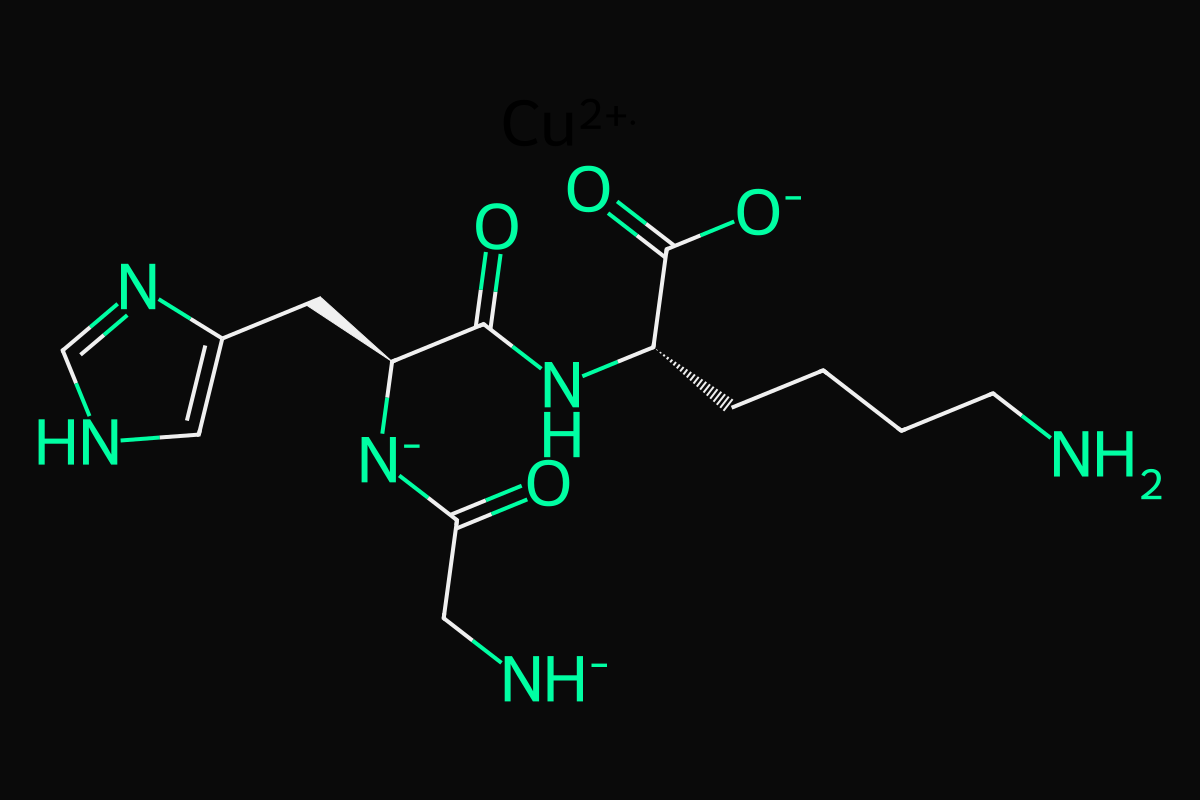
GHK-Cu is the copper(II) complex of GHK, a tripeptide of glycine, L-histidine, and L-lysine. The free tripeptide has a strong affinity for copper(II) and binds it in a 1:1 ratio. Loren Pickart first isolated GHK from human plasma in 1973. Its activity in the research literature is copper-dependent, so the peptide functions as a copper-delivery molecule. That distinguishes it mechanistically from the larger peptides in the class, which carry no metal.
| Attribute | Value |
|---|---|
| Common name | GHK-Cu (copper tripeptide-1) |
| Class | Copper(II) complex of a tripeptide |
| Peptide sequence | Glycyl-L-histidyl-L-lysine (Gly-His-Lys / GHK) |
| Tripeptide formula | C₁₄H₂₄N₆O₄ (free GHK) |
| Tripeptide molecular weight | ≈ 340.4 g/mol (free GHK) |
| GHK CAS number | 49557-75-7 (free tripeptide) |
| Copper binding | 1:1 complex with Cu(II) |
| Origin | Isolated from human plasma, 1973 (Pickart) |
What does the research literature study?#
The literature attributes broad, copper-dependent activity to the complex. A widely cited review frames GHK as a modulator of multiple cellular pathways in skin regeneration, and Pickart's gene-expression work reports modulation across collagen synthesis, extracellular-matrix remodeling, anti-inflammatory signaling, and antioxidant defense. The copper ion is integral to this activity, since it is the redox-active center the reported effects depend on. The work is preclinical and does not demonstrate human effects.
Where GHK-Cu sits in the tissue-repair class#
BPC-157 is studied for angiogenic signaling and TB-500 for actin and cell-migration dynamics, while GHK-Cu is studied for copper-dependent matrix and collagen pathways. The three target distinct mechanisms, which is the rationale for combining them. GHK-Cu is one of the four components of the KLOW research blend. See the tissue-repair cornerstone for how the class is organized, plus the BPC-157 and TB-500 profiles.
Handling and storage#
GHK-Cu ships as a distinctly blue lyophilized powder, a color that comes from the copper complex itself, and is dissolved before use. The reconstitution primer covers solvent selection, and the cold-chain article covers how storage stability shifts once the material is in solution.
Frequently asked
- What is GHK-Cu?
- GHK-Cu is the copper(II) complex of the tripeptide glycyl-L-histidyl-L-lysine (GHK), first isolated from human plasma in 1973. It functions as a copper-delivery peptide, and research studies it for copper-dependent gene modulation, collagen synthesis, and matrix remodeling. It is a laboratory research compound and is not for human use.
- Is GHK-Cu a peptide?
- Yes. GHK is a tripeptide (glycine, L-histidine, L-lysine), and GHK-Cu is its 1:1 complex with copper(II). It is the smallest member of the tissue-repair class and the only copper carrier among them, which sets it apart mechanistically from BPC-157 and TB-500.
- Why does GHK-Cu contain copper?
- The GHK tripeptide binds copper(II) with high affinity in a 1:1 ratio. In the research literature the reported activity is copper-dependent, since the copper ion is the redox-active center the effects rely on, so the complex rather than the free peptide is the studied form.
Sources and further reading#
- GHK Peptide as a Natural Modulator of Multiple Cellular Pathways in Skin Regeneration (PMC4508379): review of the copper tripeptide GHK across cellular pathways.
- Pickart, GHK and gene modulation (PMID 15780140): report of GHK-Cu modulation of gene expression across wound-healing and matrix categories.
Last updated: 2026-05-27