On this page
- What counts as a metabolic peptide?
- Which peptides make up the class?
- GLP-3 (incretin triple agonist)
- Cagrilintide (amylin analog)
- AOD9604 (growth-hormone fragment)
- Incretin versus amylin: two appetite-research pathways
- How are metabolic peptides handled in the lab?
- How Nexara handles this class
- Sources and further reading
Metabolic, Incretin & Amylin Peptides: A Research Overview
Peptides studied in metabolic and energy-balance research are often lumped together, but the molecules involved reach the same research questions by very different routes. This overview separates the three mechanism families that anchor the class, what each is studied for, and where they sit relative to one another. Everything here is laboratory-research context, not a statement about effects in people.
Three compounds anchor the class for this catalog: GLP-3, a GLP-1/GIP/glucagon receptor triple agonist; Cagrilintide, a long-acting amylin-receptor analog; and AOD9604, a fragment of growth hormone. A fourth metabolic-research peptide, the mitochondrial-derived MOTS-c, sits in the mitochondrial-targeted peptides class because its mechanism is mitochondrial rather than receptor-driven.
What counts as a metabolic peptide?#
In a research context, "metabolic peptide" describes any peptide whose preclinical studies investigate energy balance, glucose and lipid handling, appetite-regulation pathways, or related endocrine signaling. The label names a research area rather than a single receptor or mechanism. The compounds below illustrate the spread: one engages incretin receptors, one engages amylin receptors, and one is a structural fragment of a hormone. Treating them as one mechanism is the common error this overview corrects.
Which peptides make up the class?#
The table summarizes the three anchor compounds by mechanism family and receptor target. The targets do not overlap, so the grouping is by research area, not pathway.
| Compound | Mechanism family | Receptor / origin | What the literature studies |
|---|---|---|---|
| GLP-3 | Incretin triple agonist | GLP-1, GIP, and glucagon receptors | Multi-receptor incretin signaling; glucose and energy-balance models |
| Cagrilintide | Amylin-receptor analog | Amylin (AMY) and calcitonin receptors | Satiety-pathway and energy-balance research; gastric-emptying models |
| AOD9604 | Growth-hormone fragment | Derived from the hGH C-terminus (residues ~176–191) | Lipid-metabolism research without the full GH signaling profile |

GLP-3 (incretin triple agonist)#
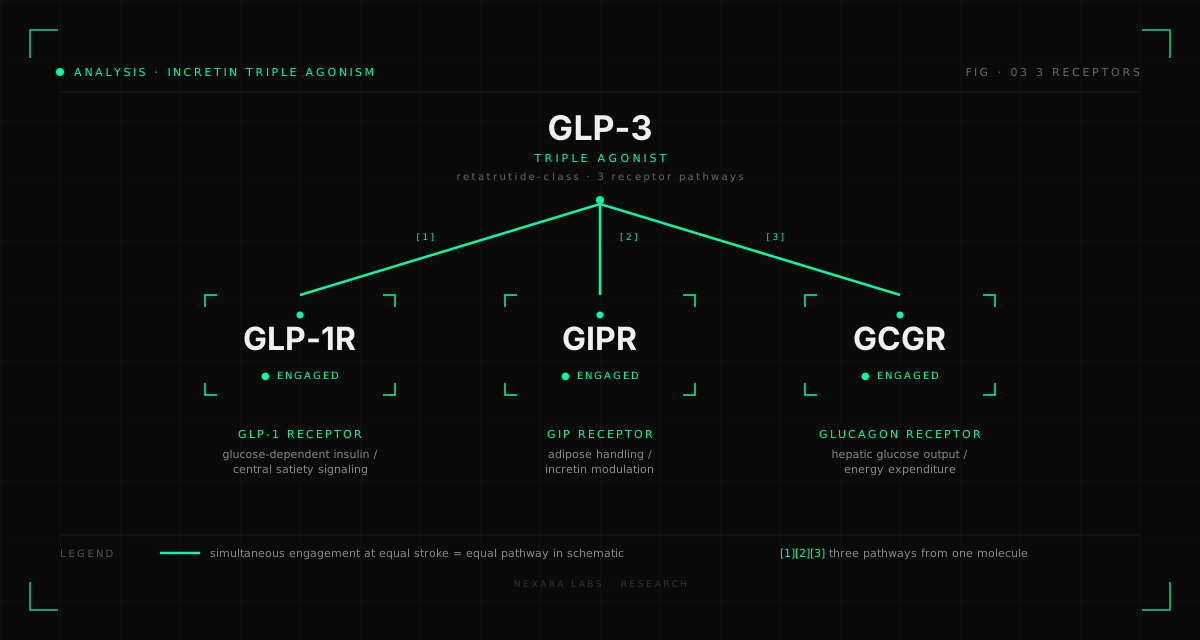
GLP-3 is this catalog's designation for a triple agonist that engages three incretin-system receptors at once: GLP-1, GIP, and glucagon. Multi-receptor agonism is the active research frontier in incretin pharmacology, and the mechanics of combining the three signals are covered in the dedicated explainer, how incretin triple agonism works. Its identity and research framing are in the GLP-3 compound profile.
Cagrilintide (amylin analog)#
Cagrilintide is a long-acting analog of amylin, a hormone co-secreted with insulin. It acts on amylin and calcitonin receptor complexes rather than the incretin receptors, which places it on a separate pathway from GLP-3 despite the shared energy-balance research area. Detail is in the Cagrilintide compound profile.
AOD9604 (growth-hormone fragment)#
AOD9604 is a synthetic fragment corresponding to the C-terminal region of growth hormone. Unlike the two receptor agonists above, it is a structural fragment studied for lipid-metabolism research, and the literature examines it for activity distinct from the full hormone's broader signaling. Detail is in the AOD9604 compound profile.
Incretin versus amylin: two appetite-research pathways#
The two receptor agonists in this class are studied in overlapping research areas but act on entirely separate receptor systems. Incretin agonists work through the GLP-1, GIP, and glucagon receptors, while amylin analogs work through amylin and calcitonin receptors. Because the systems are independent, the literature studies them both individually and in combination. The receptor mechanics of the incretin side are unpacked in how incretin triple agonism works.
How are metabolic peptides handled in the lab?#
These compounds ship lyophilized and are reconstituted before use. Several, including GLP-3 and Cagrilintide, are long-acting molecules with lipid modifications, but storage practice matches the rest of the catalog. The reconstitution primer covers solvent choice, and the cold-chain article covers stability of lyophilized versus reconstituted material. Purity context is in what ≥99% purity means. The growth-hormone secretagogue class is an adjacent class with some research-area overlap, particularly around body-composition and the broader metabolic-axis literature.
How Nexara handles this class#
Each peptide in this class is specified at ≥99% purity and labeled with a batch identifier for shipment traceability. Independent third-party COA delivery is currently paused while the testing program transitions to a new laboratory partner; the research compliance page documents the current posture. All compounds are sold strictly for laboratory research use.
Frequently asked
- What are metabolic peptides?
- It is a research grouping for peptides whose preclinical studies investigate energy balance, glucose and lipid handling, or appetite-regulation pathways. The anchor compounds here are GLP-3 (an incretin triple agonist), Cagrilintide (an amylin analog), and AOD9604 (a growth-hormone fragment). The label names a research area, not a single mechanism, and none denote an established human use.
- What is the difference between incretin agonists and amylin analogs?
- They act on different receptor systems. Incretin agonists such as GLP-3 work through the GLP-1, GIP, and glucagon receptors. Amylin analogs such as Cagrilintide work through amylin and calcitonin receptor complexes. Both appear in energy-balance research, but they are independent pathways, which is why the literature studies them separately and in combination.
- Is AOD9604 the same kind of peptide as GLP-3?
- No. AOD9604 is a fragment of growth hormone, a structural piece of a larger protein, studied for lipid-metabolism research. GLP-3 is a receptor agonist that engages three incretin receptors. They share the broad metabolic research area but have nothing in common mechanistically.
Sources and further reading#
- Cagrilintide lowers body weight through brain amylin receptors AMY1R and AMY3R (PMC12270663): receptor-mechanism study of the amylin analog Cagrilintide.
- Development of Cagrilintide, a long-acting amylin analogue, J Med Chem 2021 (doi:10.1021/acs.jmedchem.1c00565): medicinal-chemistry account of the amylin analog.
- Coskun et al., LY3437943 — a triple GLP-1/GIP/glucagon receptor agonist, Cell Metabolism 202200312-6): foundational pharmacology of an incretin triple agonist.
- Ng et al., Metabolic studies of the synthetic lipolytic domain AOD9604, Horm Res 2000 (PMID 11146367): primary study of the AOD9604 growth-hormone fragment.
Last updated: 2026-05-31
Continue your research
- Deep dive
How Incretin Triple Agonism Works: GLP-1, GIP & Glucagon
A research explainer on incretin triple agonism: what the GLP-1, GIP, and glucagon receptors do, what "triple agonist" means, and why the literature studies all three signals together.
- Next foundational
Mitochondrial-Targeted Peptides: A Research Overview
How the mitochondrial peptide class is studied: SS-31, a cardiolipin-targeting tetrapeptide, and MOTS-c, a mitochondrial-derived signaling peptide — two distinct routes to the same organelle.