On this page
How Incretin Triple Agonism Works: GLP-1, GIP & Glucagon
Incretin pharmacology has moved from single-receptor agonists toward molecules that engage two or three receptors at once. Understanding why begins with what each receptor does. This explainer walks through the GLP-1, GIP, and glucagon receptors individually, then explains what "triple agonism" adds and why the research literature pursues it. It sits within the metabolic peptides class.
What is an incretin?#
Incretins are gut-derived hormones released after nutrient intake that act on the endocrine pancreas and beyond. The two classical incretins are GLP-1 (glucagon-like peptide-1) and GIP (glucose-dependent insulinotropic polypeptide). Glucagon, while not an incretin itself, is part of the same hormonal axis and acts in an opposing direction on glucose output. Agonist peptides are studied as tools for probing how each receptor contributes to glucose and energy handling.
The three receptors#
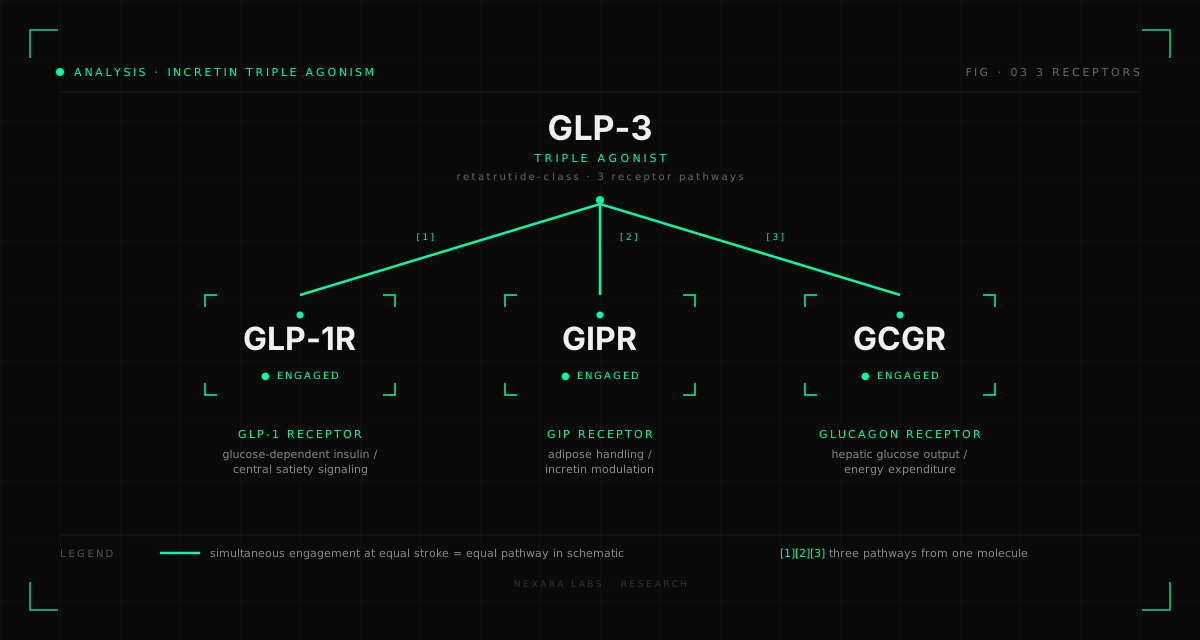
A triple agonist engages all three of the receptors below. Each is a separate G-protein-coupled receptor with a distinct role, which is the reason combining them is studied as additive rather than redundant.
| Receptor | Activating hormone | Role studied in the literature |
|---|---|---|
| GLP-1 receptor | GLP-1 | Glucose-dependent insulin signaling; slowed gastric emptying; central satiety pathways |
| GIP receptor | GIP | Insulin signaling and adipose-tissue handling; modulates the GLP-1 response |
| Glucagon receptor | Glucagon | Hepatic glucose output and energy expenditure pathways |
What does "triple agonist" mean?#
An agonist is a molecule that binds a receptor and activates it. A single peptide engineered to bind and activate the GLP-1, GIP, and glucagon receptors at once is a triple agonist. The design challenge is balance: the peptide sequence has to retain meaningful activity at all three receptors rather than collapsing into a strong single-receptor agonist. GLP-3 is this catalog's triple-agonist research compound, profiled in detail at GLP-3.
Why combine three receptors in research?#
Because each receptor governs a different pathway, engaging all three lets researchers study combined signaling that no single-receptor agonist can reproduce. The glucagon arm in particular adds an energy-expenditure dimension absent from GLP-1-only molecules. This is why triple agonism is an active research direction, and why a triple agonist is mechanistically distinct from the amylin analogs studied in the same metabolic class, such as Cagrilintide, which act on a separate receptor system entirely.
Frequently asked
- What is an incretin triple agonist?
- It is a single peptide engineered to bind and activate three receptors at once: the GLP-1, GIP, and glucagon receptors. Each governs a different arm of glucose and energy metabolism, so the three signals are studied as complementary rather than redundant. GLP-3 is an example of a triple-agonist research compound.
- What do GLP-1, GIP, and glucagon receptors each do?
- The GLP-1 receptor is studied for glucose-dependent insulin signaling, slowed gastric emptying, and central satiety pathways. The GIP receptor is studied for insulin signaling and adipose handling. The glucagon receptor is studied for hepatic glucose output and energy-expenditure pathways. A triple agonist engages all three.
- How is a triple agonist different from an amylin analog?
- A triple agonist acts on the incretin-system receptors (GLP-1, GIP, glucagon). An amylin analog such as Cagrilintide acts on amylin and calcitonin receptors, a separate system. They appear in overlapping energy-balance research but are mechanistically unrelated, which is why the literature sometimes studies them in combination.
Sources and further reading#
- Coskun et al., LY3437943 — a triple GLP-1/GIP/glucagon receptor agonist, Cell Metabolism 202200312-6): foundational pharmacology characterizing an incretin triple agonist across all three receptors.
- Cagrilintide receptor mechanism (amylin), PMC12270663: the contrasting amylin-receptor pathway referenced for comparison.
Continue your research