On this page
Neuropeptides & Cognitive-Pathway Peptides: A Research Overview
Two peptides anchor the nootropic-neuropeptide research class, and they are frequently mentioned together as a pair. Both were developed in Russia, both are short heptapeptides, and both carry the same stabilizing modification. Yet the pathways they are studied for diverge: one leans neurotrophic, the other regulatory. This overview maps the class and where the two separate, as CNS-signaling research context only.
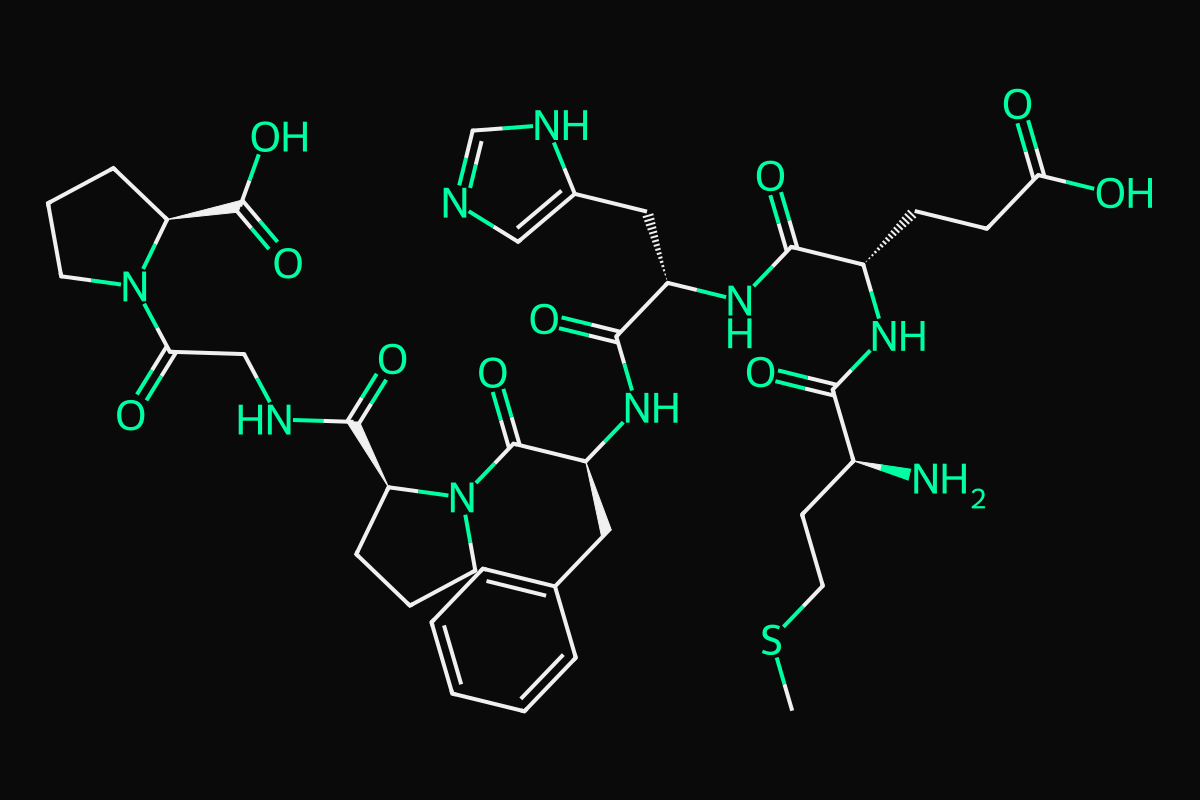
Semax derives from a fragment of adrenocorticotropic hormone (ACTH); Selank derives from the immunomodulatory peptide tuftsin. Both were engineered with a C-terminal Pro-Gly-Pro extension that resists enzymatic breakdown, which is part of why they are useful as research tools. Their shared design and divergent pathways are what the literature works with.
What are nootropic neuropeptides?#
In a research context, this class refers to short peptides whose preclinical studies investigate central-nervous-system signaling, neurotrophic factor expression, and related neurochemical pathways. The term describes the research areas these peptides appear in. The two compounds here are synthetic analogs of natural peptides, redesigned for stability, and studied as tools for probing the pathways they engage rather than as established interventions.
Which peptides make up the class?#
The table summarizes the two anchor compounds by their natural origin and the pathway the literature associates with each.
| Compound | Natural origin | Reported pathway | What the literature studies |
|---|---|---|---|
| Semax | Analog of ACTH(4-10) fragment | Neurotrophic signaling; BDNF expression | Neuroprotection and neurotrophic-factor research |
| Selank | Analog of the peptide tuftsin | GABAergic and regulatory signaling | Anxiolytic-pathway and regulatory neuropeptide research |

Semax#
Semax is a synthetic analog of the ACTH(4-10) fragment, modified with a Pro-Gly-Pro extension that increases stability and removes the hormonal activity of the parent. The literature studies it as a neurotrophic and neuroprotective agent, with reported effects on brain-derived neurotrophic factor (BDNF) expression. Detail is in the Semax compound profile.
Selank#
Selank is a synthetic analog of tuftsin, a naturally occurring immunomodulatory peptide, likewise extended with Pro-Gly-Pro for stability. Its research centers on GABAergic and regulatory signaling, distinct from the neurotrophic emphasis of Semax. Detail is in the Selank compound profile.
How do Semax and Selank differ?#
They share a design template but engage different pathways: Semax leans neurotrophic (BDNF, neuroprotection) while Selank leans regulatory (GABAergic signaling). Because the pathways are complementary rather than overlapping, the literature studies them individually and sometimes together. The full side-by-side is in Semax vs Selank.
How are these peptides handled in the lab?#
Both ship lyophilized and are reconstituted before use. As short, Pro-Gly-Pro-stabilized peptides they are relatively robust, but storage practice matches the rest of the catalog: the reconstitution primer covers solvent choice, and the cold-chain article covers stability once reconstituted. Purity context is in what ≥99% purity means. The melanocortin peptide class shares the CNS-active small-peptide research neighborhood and follows the same handling protocols.
How Nexara handles this class#
Each peptide in this class is specified at ≥99% purity and labeled with a batch identifier for shipment traceability. Independent third-party COA delivery is currently paused while the testing program transitions to a new laboratory partner; the research compliance page documents the current posture. All compounds are sold strictly for laboratory research use.
Frequently asked
- What are nootropic neuropeptides?
- In research terms, they are short peptides whose preclinical studies investigate central-nervous-system signaling and neurochemical pathways. The two here are Semax, an analog of an ACTH fragment studied for neurotrophic/BDNF activity, and Selank, an analog of tuftsin studied for GABAergic signaling. The label names research areas, not established human uses.
- What is the difference between Semax and Selank?
- They share a design (both are Pro-Gly-Pro-stabilized heptapeptide analogs) but engage different pathways. Semax leans neurotrophic, with reported effects on BDNF expression. Selank leans regulatory, acting on GABAergic signaling. Because the pathways are complementary, the literature studies them individually and sometimes together.
- Why do Semax and Selank both have a Pro-Gly-Pro extension?
- The C-terminal Pro-Gly-Pro tripeptide extension increases resistance to enzymatic breakdown, extending the stability of these short peptides relative to their natural parent sequences. It is a shared engineering feature, not a shared pathway, since the two still act on different signaling systems.
Sources and further reading#
- Semax (ACTH 4-10 analog) increases BDNF protein in rat basal forebrain (PMID 16635254): primary study of the Semax neurotrophic mechanism.
- Neurotrophin gene expression under Semax in rat brain (PMID 17353092): Semax effects on BDNF/trkB expression.
- Selank — anxiolytic neuropeptide literature, PubMed: primary literature on the Selank neuropeptide.
Last updated: 2026-05-31
Continue your research
- Deep dive
Semax vs Selank: How Two Nootropic Neuropeptides Differ
Semax and Selank share a design but engage different pathways — neurotrophic vs GABAergic. A research comparison of their origins, mechanisms, and why they are studied together.
- Next foundational
What ≥99% Purity Actually Means: HPLC Explained
A deep technical reference on what HPLC actually measures, how peptide purity is calculated, why ≥99% is the working threshold, and what falls below it.