

On this page
Semax: Compound Profile
Semax is the neurotrophic member of the nootropic-neuropeptide class, the counterpart to the regulatory-leaning Selank. This profile covers its identity, the mechanism the literature attributes to it, and how it relates to Selank. For the class, see the neuropeptides overview.
What is Semax?#
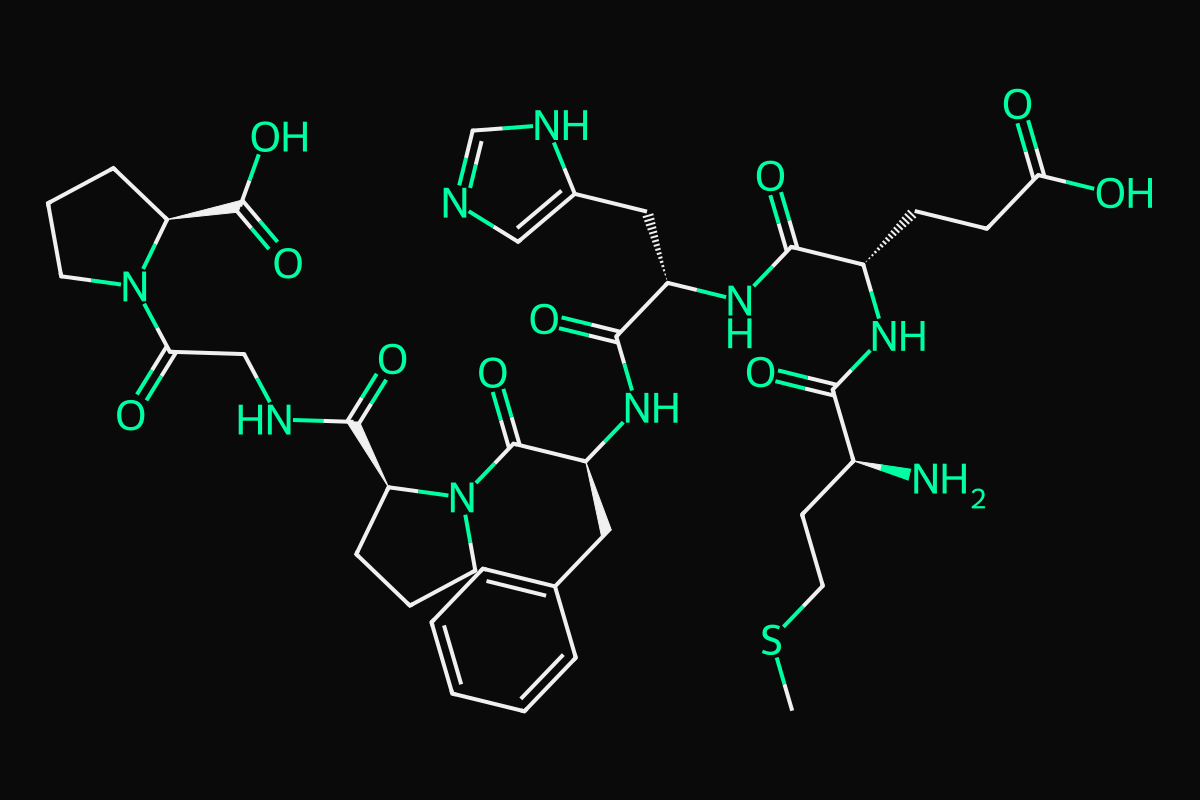
Semax is a synthetic peptide modeled on the 4-10 fragment of adrenocorticotropic hormone (ACTH), with a Pro-Gly-Pro tripeptide added at the C-terminus. That extension increases stability and the analog lacks the corticotropic (hormonal) activity of the parent, so it acts purely as a neuropeptide. It was developed in Russia and is studied as a neuroprotective and neurotrophic agent.
| Attribute | Value |
|---|---|
| Common name | Semax |
| Class | Synthetic ACTH(4-10) analog; heptapeptide |
| Sequence | Met-Glu-His-Phe-Pro-Gly-Pro (MEHFPGP) |
| CAS number | 80714-61-0 |
| Stabilizing feature | C-terminal Pro-Gly-Pro extension |
| Primary study area | Neurotrophic and neuroprotective research (BDNF pathway) |
What does the research literature study?#
Semax is studied as a neurotrophic and neuroprotective agent. The most frequently cited reported mechanism is upregulation of brain-derived neurotrophic factor (BDNF) expression, alongside related neurotrophic signaling. Because it lacks the hormonal activity of its ACTH parent, the research focus is on these CNS-signaling pathways rather than endocrine effects. This is preclinical and pharmacology research; it does not establish cognitive or other outcomes in people.
How it relates to Selank#
Semax leans neurotrophic; Selank leans regulatory (GABAergic signaling). The two share a Pro-Gly-Pro-stabilized design but act on different pathways, which is why the literature studies them as a complementary pair. The full breakdown is in Semax vs Selank.
Handling and storage#
Semax ships lyophilized and is dissolved prior to use. As a short stabilized peptide it is reasonably robust, but storage is standard across the catalog: the reconstitution primer covers solvent choice, and the cold-chain article covers stability once reconstituted.
Frequently asked
- What is Semax?
- Semax is a synthetic heptapeptide analog of the ACTH(4-10) fragment (sequence MEHFPGP), stabilized with a C-terminal Pro-Gly-Pro extension and lacking the parent's hormonal activity. Research studies it as a neurotrophic and neuroprotective agent. It is a laboratory research compound and is not for human use.
- What is the reported mechanism of Semax?
- The most-cited mechanism in the literature is upregulation of brain-derived neurotrophic factor (BDNF) expression, alongside related neurotrophic signaling. Because it lacks ACTH's hormonal activity, the research focus is on CNS-signaling pathways. The work is preclinical and does not demonstrate outcomes in people.
- How is Semax different from Selank?
- Both are Pro-Gly-Pro-stabilized heptapeptide analogs, but Semax (from an ACTH fragment) is studied for neurotrophic/BDNF activity, while Selank (from tuftsin) is studied for GABAergic signaling. They act on different pathways and are studied as complementary research tools.
Sources and further reading#
- Semax (ACTH 4-10 analog) increases BDNF protein in rat basal forebrain (PMID 16635254): primary study of the Semax–BDNF mechanism.
- Neurotrophin gene expression in rat brain under Semax (PMID 17353092): Semax effects on BDNF and trkB expression.
Last updated: 2026-05-27