On this page
Mitochondrial-Targeted Peptides: A Research Overview
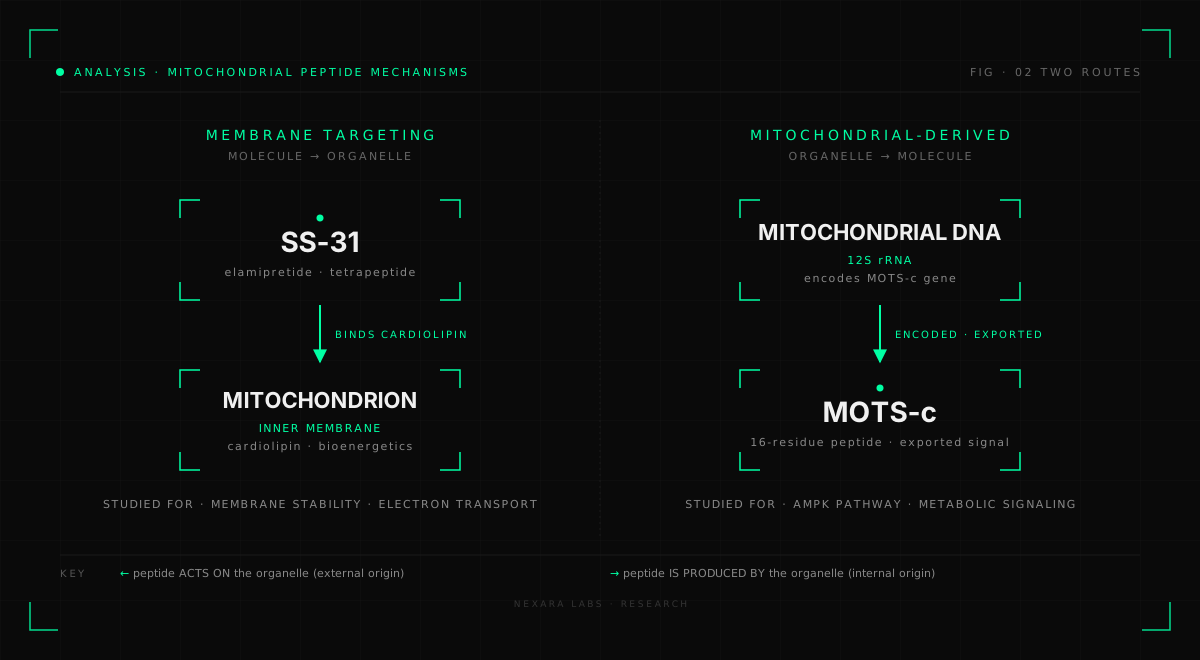
The "mitochondrial peptide" label hides a genuinely interesting split. One compound in this class is a designed molecule that homes to a specific lipid in the mitochondrial membrane. The other is a natural peptide the mitochondrion encodes and exports as a signal. This overview maps both, what each is studied for, and why they represent two different research stories about the same organelle.
SS-31 (also called elamipretide) is a cardiolipin-targeting tetrapeptide studied for mitochondrial bioenergetics. MOTS-c is a mitochondrial-derived peptide studied as a metabolic regulator, which also gives it a foot in the metabolic peptide research area. Their mechanisms could hardly be more different, which is what makes the pairing worth understanding.
What are mitochondrial-targeted peptides?#
In a research context, this class covers peptides whose studies center on mitochondria, whether they act on the organelle or originate from it. The two anchor compounds illustrate both directions: SS-31 is a synthetic peptide engineered to accumulate at the inner mitochondrial membrane, while MOTS-c is a mitochondrial-derived peptide (MDP) encoded within the mitochondrial genome. The grouping is by organelle relevance, not by a shared mechanism.
Which peptides make up the class?#
The table summarizes the two anchor compounds by type and the pathway the literature associates with each. The mechanisms do not overlap, so the grouping is by research area.
| Compound | Type | Target / origin | What the literature studies |
|---|---|---|---|
| SS-31 | Cardiolipin-targeting tetrapeptide | Cardiolipin, inner mitochondrial membrane | Mitochondrial bioenergetics and membrane research |
| MOTS-c | Mitochondrial-derived peptide (MDP) | Encoded in mitochondrial 12S rRNA; AMPK signaling | Metabolic-regulation and cellular-stress research |

SS-31#
SS-31 is a synthetic tetrapeptide that concentrates at the inner mitochondrial membrane by binding cardiolipin, a phospholipid central to membrane structure and electron-transport efficiency. The literature studies it for mitochondrial bioenergetics. Detail is in the SS-31 compound profile.
MOTS-c#
MOTS-c is a mitochondrial-derived peptide, encoded within the mitochondrial genome rather than the nuclear genome, that functions as a signaling molecule. Its research centers on metabolic regulation and the AMPK pathway, distinct from SS-31's membrane mechanism. Detail is in the MOTS-c compound profile.
Two ways to engage the mitochondria#
SS-31 acts on the mitochondrion from outside its genome, homing to a membrane lipid. MOTS-c originates inside the mitochondrion and acts as an exported signal. That difference, a molecule that targets the organelle versus one the organelle produces, is the conceptual core of the class. It is unpacked in how mitochondrial-targeted peptides work.
How are mitochondrial peptides handled in the lab?#
Both ship lyophilized and are reconstituted before use. They differ widely in size, SS-31 is a tetrapeptide and MOTS-c a 16-residue peptide, but storage practice matches the rest of the catalog: the reconstitution primer covers solvent choice, and the cold-chain article covers stability once reconstituted. Purity context is in what ≥99% purity means. MOTS-c overlaps the metabolic peptide research area despite its organellar origin, and the melanocortin peptide class is an adjacent pathway-pharmacology neighborhood worth knowing for cross-class research.
How Nexara handles this class#
Each peptide in this class is specified at ≥99% purity and labeled with a batch identifier for shipment traceability. Independent third-party COA delivery is currently paused while the testing program transitions to a new laboratory partner; the research compliance page documents the current posture. All compounds are sold strictly for laboratory research use.
Frequently asked
- What are mitochondrial-targeted peptides?
- In research terms, they are peptides whose studies center on mitochondria, whether they act on the organelle or originate from it. The two here are SS-31, a synthetic tetrapeptide that targets cardiolipin in the inner mitochondrial membrane, and MOTS-c, a peptide encoded within mitochondrial DNA that acts as a metabolic signal. The label names a research area, not an established human use.
- What is the difference between SS-31 and MOTS-c?
- Their relationship to the mitochondrion. SS-31 is a synthetic peptide that targets the organelle, binding cardiolipin in the inner membrane and studied for bioenergetics. MOTS-c is a mitochondrial-derived peptide that comes from the organelle, encoded in mitochondrial DNA and studied as a metabolic signaling molecule via the AMPK pathway.
- Is MOTS-c a metabolic peptide or a mitochondrial peptide?
- Both, depending on the lens. It is a mitochondrial-derived peptide by origin, which is why it anchors the mitochondrial class, and a metabolic regulator by function, which is why it also appears in metabolic-peptide research. The classification reflects that it sits at the intersection of the two areas.
Sources and further reading#
- Elamipretide (SS-31): structure, mechanism, and cardiolipin targeting — review (PMC11816484): review of the cardiolipin-targeting tetrapeptide.
- Lee et al., The mitochondrial-derived peptide MOTS-c promotes metabolic homeostasis, Cell Metabolism 2015 (PMID 25738459): the foundational MOTS-c discovery paper.
Last updated: 2026-05-31
Continue your research
- Deep dive
How Mitochondrial-Targeted Peptides Work
A research explainer on the two ways peptides engage mitochondria: membrane-targeting (binding cardiolipin, as SS-31 does) and mitochondrial-derived signaling (as MOTS-c does).
- Next foundational
Neuropeptides & Cognitive-Pathway Peptides: A Research Overview
How the nootropic neuropeptide class is studied: Semax (an ACTH-fragment analog) and Selank (a tuftsin analog), the CNS signaling pathways they engage, and how they differ.