On this page
How Mitochondrial-Targeted Peptides Work
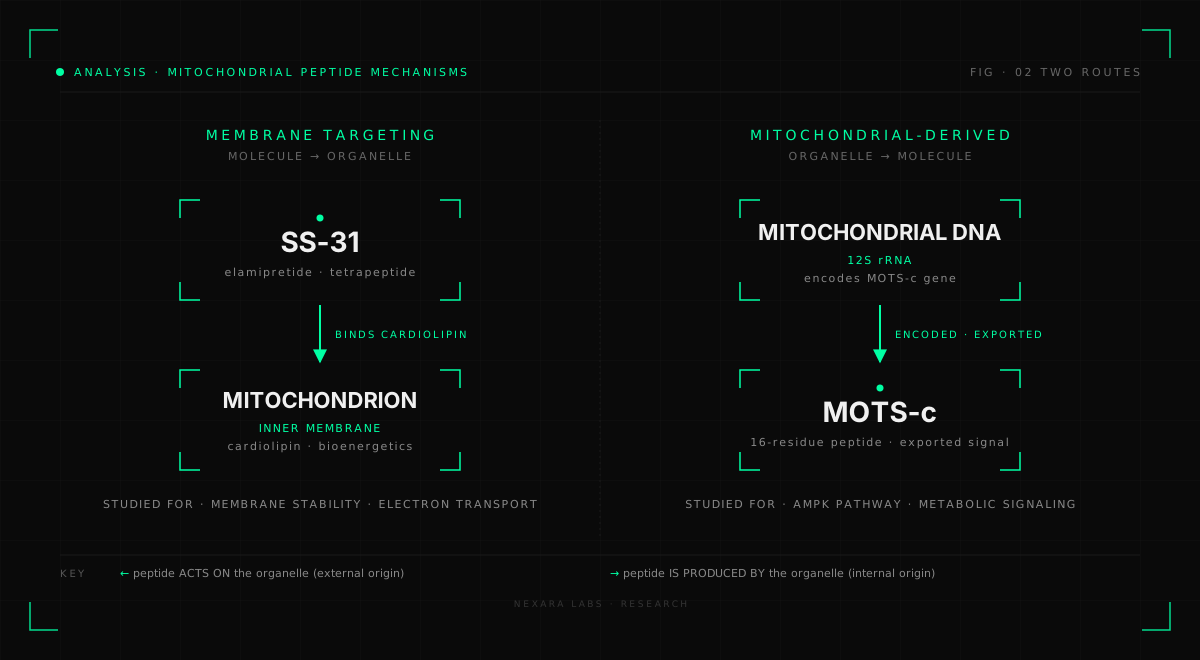
Mitochondrial peptide research only makes sense once you separate "peptides that target mitochondria" from "peptides that mitochondria make." They sound like one category and are really two. This explainer walks through both mechanisms using the two compounds in the class, then explains why the distinction matters for what each is studied for. It sits within the mitochondrial peptides class.
Mechanism one: membrane targeting#
The inner mitochondrial membrane is where the electron-transport chain lives, and a phospholipid called cardiolipin is central to its structure and function. A membrane-targeting peptide is engineered to carry a charge pattern that concentrates it at this membrane, where it associates with cardiolipin. SS-31 is the example in this class: a small tetrapeptide studied for its association with cardiolipin and the resulting effects on membrane organization and bioenergetics. The peptide is external in origin but acts on the organelle.
Mechanism two: mitochondrial-derived signaling#
Mitochondria carry their own small genome, and parts of it encode short peptides, the mitochondrial-derived peptides (MDPs). These are produced inside the mitochondrion and exported to act as signaling molecules elsewhere in the cell and body. MOTS-c is the example here: encoded within the mitochondrial 12S rRNA region and studied as a regulator of metabolic pathways, notably AMPK signaling. The peptide originates from the organelle and acts as a messenger.
| Aspect | Membrane-targeting (SS-31) | Mitochondrial-derived (MOTS-c) |
|---|---|---|
| Origin | Synthetic / external | Encoded in mitochondrial DNA |
| Direction | Acts on the organelle | Comes from the organelle |
| Target / role | Binds cardiolipin in the inner membrane | Exported signaling molecule (AMPK pathway) |
| Research area | Bioenergetics, membrane integrity | Metabolic regulation, cellular stress |
Why the distinction matters#
The two mechanisms are studied for different questions. Membrane-targeting research asks how stabilizing the inner membrane affects energy production. Mitochondrial-derived-peptide research asks how the organelle signals to the rest of the cell about metabolic state. Grouping the two under "mitochondrial peptides" is convenient, but treating them as one mechanism is the error this explainer corrects. Both compounds are detailed in their profiles: SS-31 and MOTS-c.
Frequently asked
- What does it mean for a peptide to "target" mitochondria?
- A membrane-targeting peptide carries a charge pattern that concentrates it at the inner mitochondrial membrane, where it associates with the phospholipid cardiolipin. SS-31 is the example in this class. The peptide is external in origin but accumulates at and acts on the organelle, which is what "targeting" refers to.
- What is a mitochondrial-derived peptide?
- A mitochondrial-derived peptide (MDP) is a short peptide encoded within the mitochondrial genome rather than the nuclear genome. MOTS-c is one: it is produced inside the mitochondrion and exported to act as a signaling molecule, notably in the AMPK metabolic pathway. It comes from the organelle rather than targeting it.
- How are SS-31 and MOTS-c different mechanistically?
- SS-31 targets the mitochondrion from outside, binding cardiolipin in the inner membrane and studied for bioenergetics. MOTS-c originates inside the mitochondrion, encoded in its DNA, and acts as an exported metabolic signal. One acts on the organelle; the other is produced by it.
Sources and further reading#
- Mitochondrial protein interaction landscape of SS-31 (PMC7334473): study of the cardiolipin-targeting (membrane) mechanism.
- Lee et al., MOTS-c promotes metabolic homeostasis, Cell Metabolism 2015 (PMID 25738459): foundational study of a mitochondrial-derived signaling peptide.
Continue your research