On this page
- What is a growth-hormone secretagogue?
- Which peptides make up the class?
- CJC-1295 (with DAC)
- Ipamorelin
- Tesamorelin
- How do GHRH analogs and ghrelin-receptor agonists differ?
- Why are the two families studied together?
- How are these peptides handled in the lab?
- How Nexara handles this class
- Sources and further reading
Growth-Hormone Secretagogues & GHRH Analogs: A Research Overview
A growth-hormone secretagogue is any compound studied for its ability to prompt the pituitary to release growth hormone. The peptides grouped here share that endpoint, but they reach it through two distinct receptors. Knowing which family a compound belongs to, GHRH analog or ghrelin-receptor agonist, is the single most useful distinction in the class, and it is the one most often blurred.
This overview maps the class for laboratory-research context only: the receptor each compound targets, how the two mechanism families differ, and why a GHRH analog and a ghrelin-receptor agonist are frequently examined together. It is a discussion of mechanism, not outcome. Nothing here describes effects in humans.
What is a growth-hormone secretagogue?#
In research terms, a growth-hormone secretagogue acts on the anterior pituitary to stimulate growth-hormone release, rather than being growth hormone itself. The peptides in this class are studied as tools for probing the GH axis. They fall into two receptor families: analogs of growth-hormone-releasing hormone (GHRH), which act on the GHRH receptor, and agonists of the ghrelin / growth-hormone-secretagogue receptor (GHS-R). Both raise GH signaling, but through separate pathways with different release kinetics.
Which peptides make up the class?#
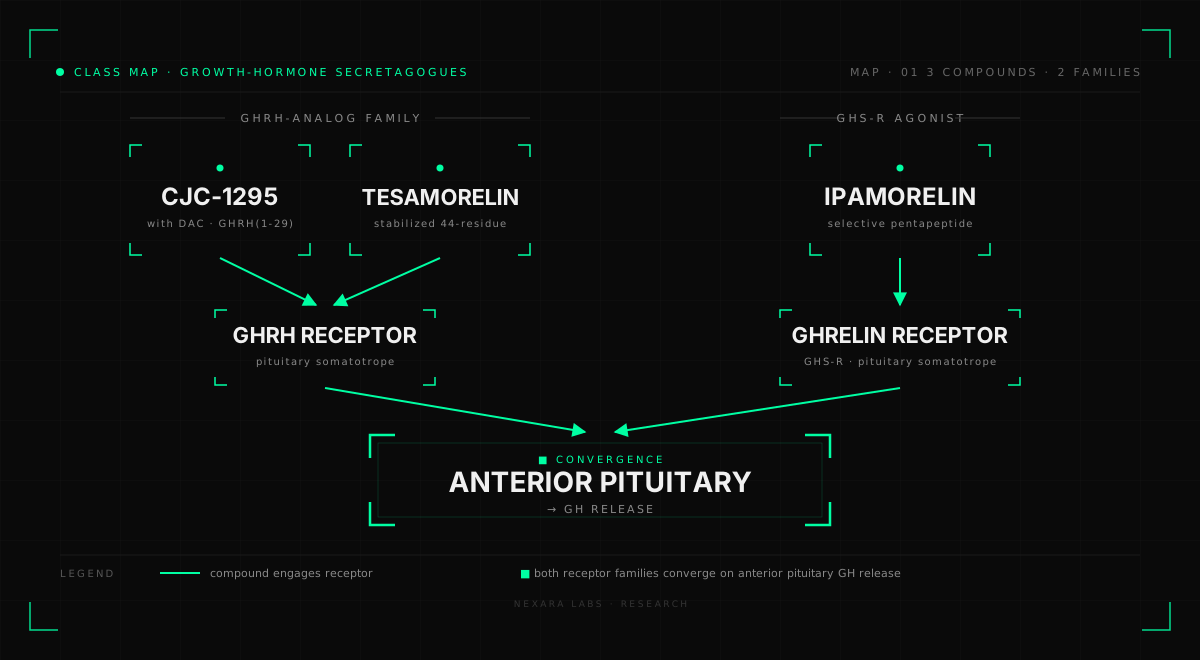
Three compounds anchor the class. The table summarizes each by mechanism family, receptor target, and the property that most distinguishes it. CJC-1295 and Tesamorelin share the GHRH-analog family while Ipamorelin sits in the ghrelin-receptor family, so the grouping is by endpoint, not by mechanism.
| Compound | Mechanism family | Receptor target | Distinguishing property |
|---|---|---|---|
| CJC-1295 (DAC) | GHRH analog | GHRH receptor | Albumin-binding DAC extends half-life to days (sustained signaling) |
| Ipamorelin | Ghrelin-receptor agonist | GHS-R (ghrelin receptor) | Highly selective pentapeptide; pulsatile release |
| Tesamorelin | GHRH analog | GHRH receptor | Stabilized 44-residue GHRH analog |
CJC-1295 (with DAC)#
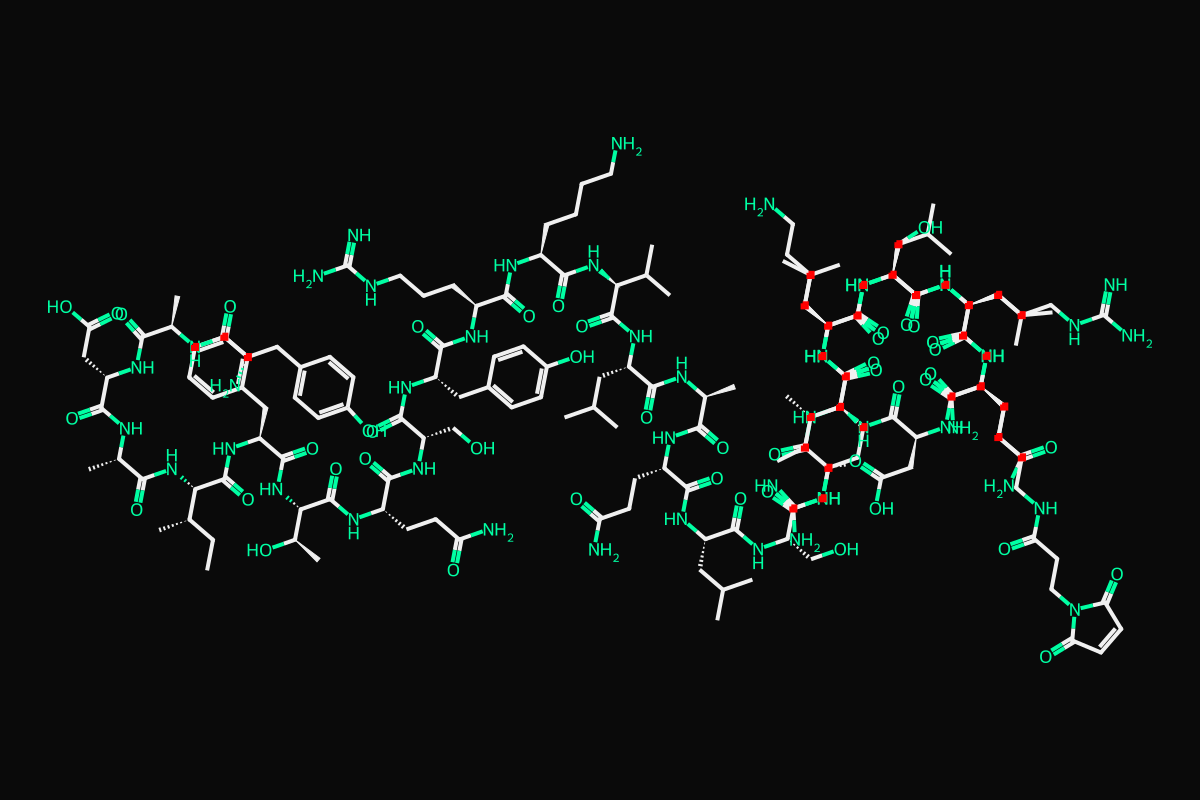
CJC-1295 is a synthetic analog of GHRH(1-29) carrying four amino-acid substitutions for protease resistance plus a Drug Affinity Complex (DAC), a maleimido-lysine group that binds covalently to serum albumin and extends its persistence from minutes to days. Its identity and research context are detailed in the CJC-1295 (DAC) compound profile.
Ipamorelin#
Ipamorelin is a highly selective synthetic pentapeptide that acts as an agonist at the ghrelin / GHS receptor, a different receptor from the GHRH analogs. It was characterized as one of the first selective growth-hormone secretagogues. Full detail is in the Ipamorelin compound profile.
Tesamorelin#
Tesamorelin is a stabilized 44-residue analog of human GHRH, distinguished by an N-terminal trans-3-hexenoyl modification that improves stability. Like CJC-1295 it is a GHRH-receptor analog. Its identity and research framing are covered in the Tesamorelin compound profile.
How do GHRH analogs and ghrelin-receptor agonists differ?#
GHRH analogs (CJC-1295, Tesamorelin) bind the GHRH receptor and are studied for sustained, GHRH-pattern signaling, especially CJC-1295, whose albumin-binding DAC extends activity into a multi-day window. Ghrelin-receptor agonists (Ipamorelin) bind the separate GHS-R and are studied for shorter, pulse-like release that more closely tracks the body's natural GH rhythm. Because the receptors are distinct, the two families are not substitutes. They are different experimental levers on the same axis.
Why are the two families studied together?#
Because a GHRH analog and a ghrelin-receptor agonist act on separate receptors, the literature frequently examines them in combination, where the two signals reportedly amplify GH release beyond either alone. The canonical pairing is CJC-1295 with Ipamorelin, and the full side-by-side is in CJC-1295 vs Ipamorelin. Combined study is about mechanistic complementarity, not a benefit claim.
How are these peptides handled in the lab?#
All three ship as lyophilized powder and are reconstituted before use. CJC-1295 with DAC is notable for its extended stability profile, but handling follows the same standard practice as the rest of the catalog. See the reconstitution and lyophilization primer and the cold-chain article, plus what ≥99% purity means for purity context. The tissue-repair peptide class follows identical handling protocols and is a useful adjacent reference for researchers working across both classes.
How Nexara handles this class#
Each peptide in this class is specified at ≥99% purity and labeled with a batch identifier for shipment traceability. Independent third-party COA delivery is currently paused while the testing program transitions to a new laboratory partner; the research compliance page documents the current posture. All compounds are sold strictly for laboratory research use.
Frequently asked
- What is a growth-hormone secretagogue?
- It is a compound studied for its ability to make the anterior pituitary release growth hormone, rather than being growth hormone itself. The research class divides into two receptor families: GHRH analogs (CJC-1295, Tesamorelin), which act on the GHRH receptor, and ghrelin-receptor agonists (Ipamorelin), which act on the GHS-R. Both are studied as tools for probing the GH axis, and neither denotes an established human use.
- What is the difference between CJC-1295 and Ipamorelin?
- They act on different receptors. CJC-1295 is a GHRH analog (GHRH receptor) and, with its albumin-binding DAC, is studied for sustained multi-day signaling. Ipamorelin is a selective ghrelin-receptor (GHS-R) agonist studied for shorter, pulse-like release. Because the receptors differ, they are complementary rather than interchangeable, and are often examined together.
- Are CJC-1295 and Tesamorelin the same kind of peptide?
- Both are GHRH analogs that act on the GHRH receptor, but they are distinct molecules. Tesamorelin is a stabilized 44-residue GHRH analog with an N-terminal trans-3-hexenoyl modification, while CJC-1295 is a modified GHRH(1-29) fragment with four substitutions plus a Drug Affinity Complex that binds albumin to extend its half-life. They differ in length, structure, and persistence.
Sources and further reading#
- Tesamorelin — DrugBank DB08869: structured pharmacology entry for the GHRH analog tesamorelin (mechanism, target, chemistry).
- Tesamorelin — NCBI Bookshelf / LiverTox (NBK548730): NIH reference covering tesamorelin as a GHRH analog.
- Raun et al., Ipamorelin, the first selective growth hormone secretagogue, Eur J Endocrinol 1998 (PMID 9849822): primary characterization of ipamorelin and the GHS-R mechanism.
- Teichman et al., Prolonged GH/IGF-I secretion by CJC-1295, J Clin Endocrinol Metab 2006 (PMID 16352683): foundational pharmacology study of the long-acting GHRH analog CJC-1295.
Last updated: 2026-05-31
Continue your research
- Deep dive
CJC-1295 vs Ipamorelin: How Two GH Secretagogues Differ
CJC-1295 and Ipamorelin act on different receptors, GHRH vs ghrelin/GHS-R. A research comparison of their mechanisms, release kinetics, and why the literature pairs them.
- Next foundational
How to Read a Certificate of Analysis
A field-by-field walkthrough of a research peptide Certificate of Analysis: what each line means, what to verify, and what should make a researcher reject a batch.