

On this page
Ipamorelin: Compound Profile
Ipamorelin is the ghrelin-receptor member of the growth-hormone secretagogue class, mechanistically separate from the GHRH analogs it is so often paired with. This profile covers its identity, the selective-secretagogue mechanism, and its research framing. For its place in the class, see the GH secretagogues overview.
What is Ipamorelin?#
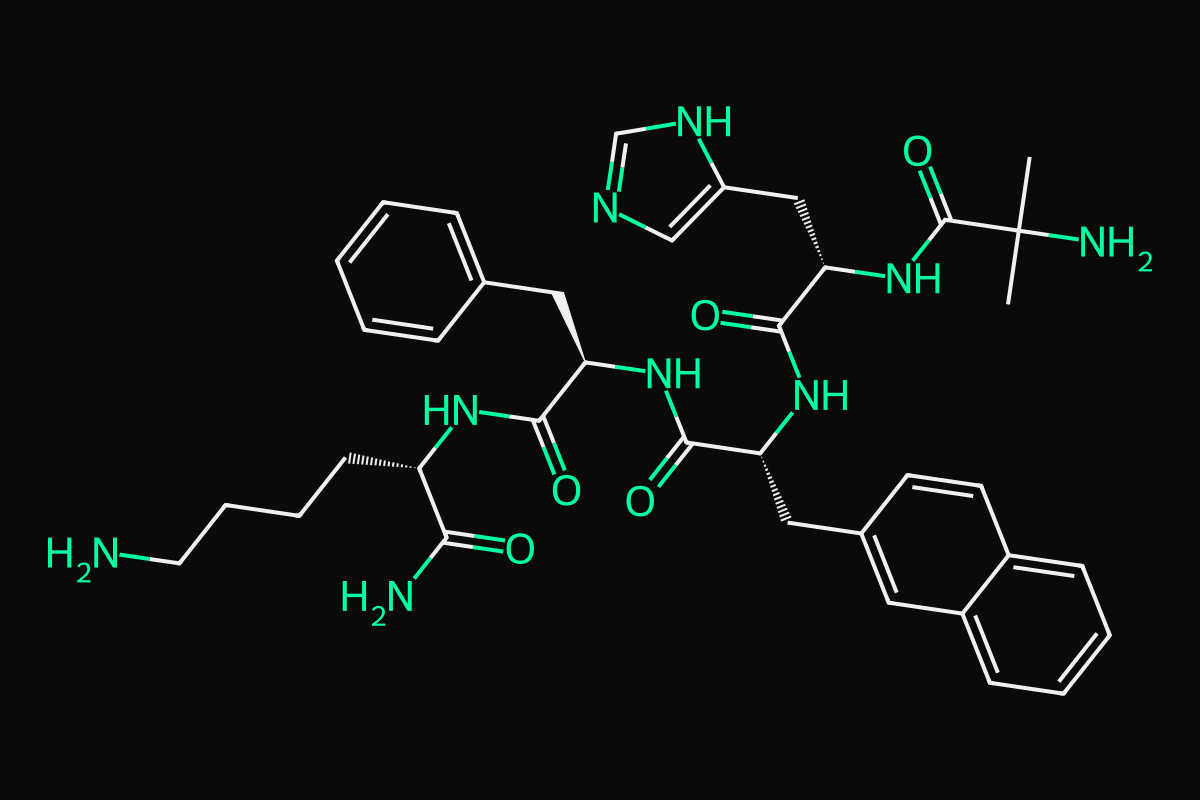
Ipamorelin is a synthetic pentapeptide of five amino acids, two of them non-standard: aminoisobutyric acid (Aib) and D-2-naphthylalanine (D-2-Nal). It acts as an agonist at the ghrelin / growth-hormone-secretagogue receptor (GHS-R), the same receptor the hormone ghrelin engages. Its defining property in the literature is selectivity, since it stimulates GH release with minimal effect on other pituitary hormones, and that selectivity is why it was described as one of the first truly selective GH secretagogues.
| Attribute | Value |
|---|---|
| Common name | Ipamorelin (NNC26-0161) |
| Class | Selective ghrelin-receptor (GHS-R) agonist; pentapeptide |
| Sequence | Aib-His-D-2-Nal-D-Phe-Lys-NH₂ |
| Molecular formula | C₃₈H₄₉N₉O₅ |
| Molecular weight | ≈ 711.9 g/mol |
| CAS number | 170851-70-4 |
| Non-standard residues | Aib (aminoisobutyric acid), D-2-Nal (D-2-naphthylalanine) |
What does the research literature study?#
Ipamorelin binds the GHS-R and is studied for pulse-like growth-hormone release that tracks the body's natural GH rhythm more closely than the sustained pattern of long-acting GHRH analogs. Its original characterization by Raun and colleagues (1998) established the selectivity that defines its research interest. Framing centers on that receptor selectivity and release pattern, not on any downstream human outcome.
How it relates to the GHRH analogs#
Ipamorelin acts on the ghrelin / GHS receptor and produces pulsatile release. CJC-1295 acts on the separate GHRH receptor and produces sustained signaling, so the literature pairs the two for their complementary mechanisms. See CJC-1295 vs Ipamorelin for the comparison, and the pairing compound is cataloged as CJC-1295 (DAC).
Handling and storage#
Ipamorelin is shipped lyophilized and dissolved before use. The reconstitution primer addresses solvent choice, and the cold-chain article addresses storage stability once the powder is reconstituted.
Frequently asked
- What is Ipamorelin?
- Ipamorelin is a synthetic pentapeptide (Aib-His-D-2-Nal-D-Phe-Lys-NH₂) that acts as a selective agonist of the ghrelin / growth-hormone-secretagogue receptor (GHS-R). Research studies it for pulse-like GH release with high selectivity. It is a laboratory research compound and is not for human use.
- What receptor does Ipamorelin act on?
- Ipamorelin acts on the ghrelin / GHS receptor (GHS-R), the same receptor the hormone ghrelin engages. That is a different receptor from the GHRH analogs CJC-1295 and Tesamorelin, which is why Ipamorelin is studied as a complement to them rather than a substitute.
- Why is Ipamorelin called "selective"?
- Because its 1998 characterization reported that it stimulates growth-hormone release with minimal effect on other pituitary hormones such as cortisol or prolactin, unlike some earlier secretagogues. That selectivity is the property that made it a reference compound in GHS-R research.
Sources and further reading#
- Raun et al., Ipamorelin, the first selective growth hormone secretagogue, Eur J Endocrinol 1998 (PMID 9849822): primary characterization of ipamorelin and its GHS-R selectivity.
Last updated: 2026-05-27