

On this page
CJC-1295 (DAC): Compound Profile
CJC-1295 is one of two GHRH analogs in the growth-hormone secretagogue class, and the one defined by its half-life. This profile covers what it is, how the DAC modification works, and what the literature studies, all as laboratory-research context. For its place in the class, see the GH secretagogues overview.
What is CJC-1295 (DAC)?#
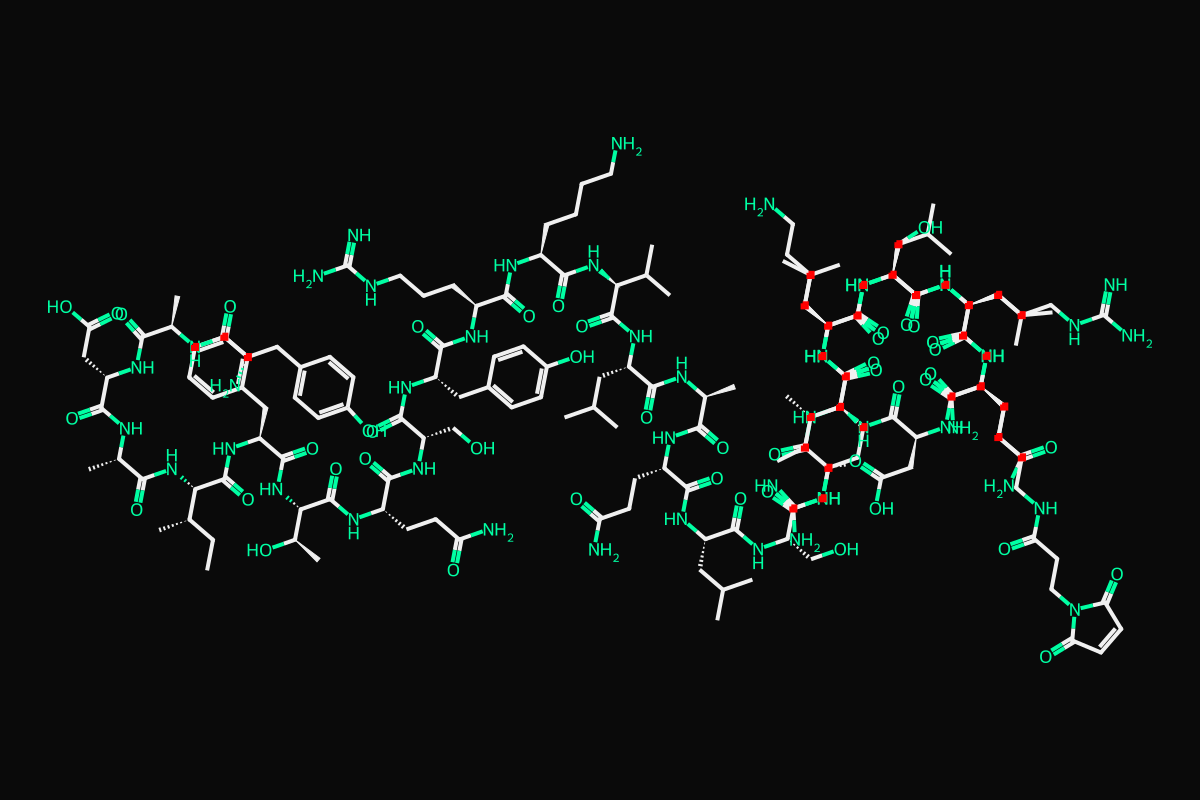
CJC-1295 is a synthetic analog of the first 29 residues of growth-hormone-releasing hormone, GHRH(1-29), which is the bioactive core of GHRH. Four amino-acid substitutions make it resistant to enzymatic degradation. The "DAC" version adds a Drug Affinity Complex: a maleimido-lysine group at the C-terminus that bonds covalently to a free thiol (Cys34) on serum albumin after administration. Tethered to albumin, the peptide circulates for days rather than minutes, which is the property that sets it apart within the class.
| Attribute | Value |
|---|---|
| Common name | CJC-1295 with DAC (drug affinity complex) |
| Class | Long-acting GHRH(1-29) analog |
| Base structure | Modified GRF(1-29) with 4 substitutions + DAC |
| DAC mechanism | Maleimido-lysine binds Cys34 of serum albumin |
| Molecular weight | ≈ 3367 g/mol (free base; reported values vary with how the DAC conjugate is counted) |
| CAS number | 863288-34-0 (with DAC; 446036-97-1 without DAC) |
| Reported half-life | ≈ 6–8 days (vs ~30 min unmodified) |
What does the research literature study?#
CJC-1295 binds the GHRH receptor on the anterior pituitary, and the literature studies the sustained, GHRH-pattern signaling its extended half-life allows. The foundational pharmacology comes from Teichman and colleagues (2006), who documented prolonged GH and IGF-I stimulation and established the multi-day persistence that separates it from short-acting GHRH peptides. Research framing centers on that durability of receptor engagement, not on any downstream human outcome.
How it relates to the other secretagogues#
CJC-1295 acts on the GHRH receptor and is studied for sustained signaling. Ipamorelin acts on the separate ghrelin / GHS receptor and is studied for pulsatile release, so the two are frequently paired in research for their complementary mechanisms. The full breakdown is in CJC-1295 vs Ipamorelin, and the pairing compound is cataloged as Ipamorelin.
Handling and storage#
CJC-1295 is shipped as a lyophilized solid for reconstitution. The reconstitution primer covers solvent choice, and the cold-chain article covers how stability differs between the dry powder and the reconstituted solution.
Frequently asked
- What is CJC-1295 with DAC?
- It is a synthetic analog of GHRH(1-29) with four substitutions for stability plus a Drug Affinity Complex (DAC) that binds serum albumin and extends its persistence to a reported 6–8 days. Research studies it for sustained GHRH-receptor signaling. It is a laboratory research compound and is not for human use.
- What is the difference between CJC-1295 with and without DAC?
- The DAC is a maleimido-lysine group that binds covalently to albumin and extends half-life from about 30 minutes (without DAC, the "Modified GRF 1-29" form) to roughly 6–8 days (with DAC). The DAC version is studied for sustained signaling, while the non-DAC form more closely mimics short, natural GHRH pulses.
- What receptor does CJC-1295 act on?
- CJC-1295 is a GHRH analog and acts on the GHRH receptor in the anterior pituitary. That is a different receptor from the one Ipamorelin engages (the ghrelin / GHS receptor), which is why the two are studied as complementary compounds rather than equivalents.
Sources and further reading#
- Teichman et al., Prolonged GH/IGF-I secretion by CJC-1295, J Clin Endocrinol Metab 2006 (PMID 16352683): foundational pharmacology study of the long-acting GHRH analog CJC-1295.
Last updated: 2026-05-27