

On this page
Tesamorelin: Compound Profile
Tesamorelin is the longer of the two GHRH analogs in the growth-hormone secretagogue class. This profile stays deliberately limited to molecular identity and receptor mechanism, as laboratory-research context. For its place in the class, see the GH secretagogues overview.
What is Tesamorelin?#
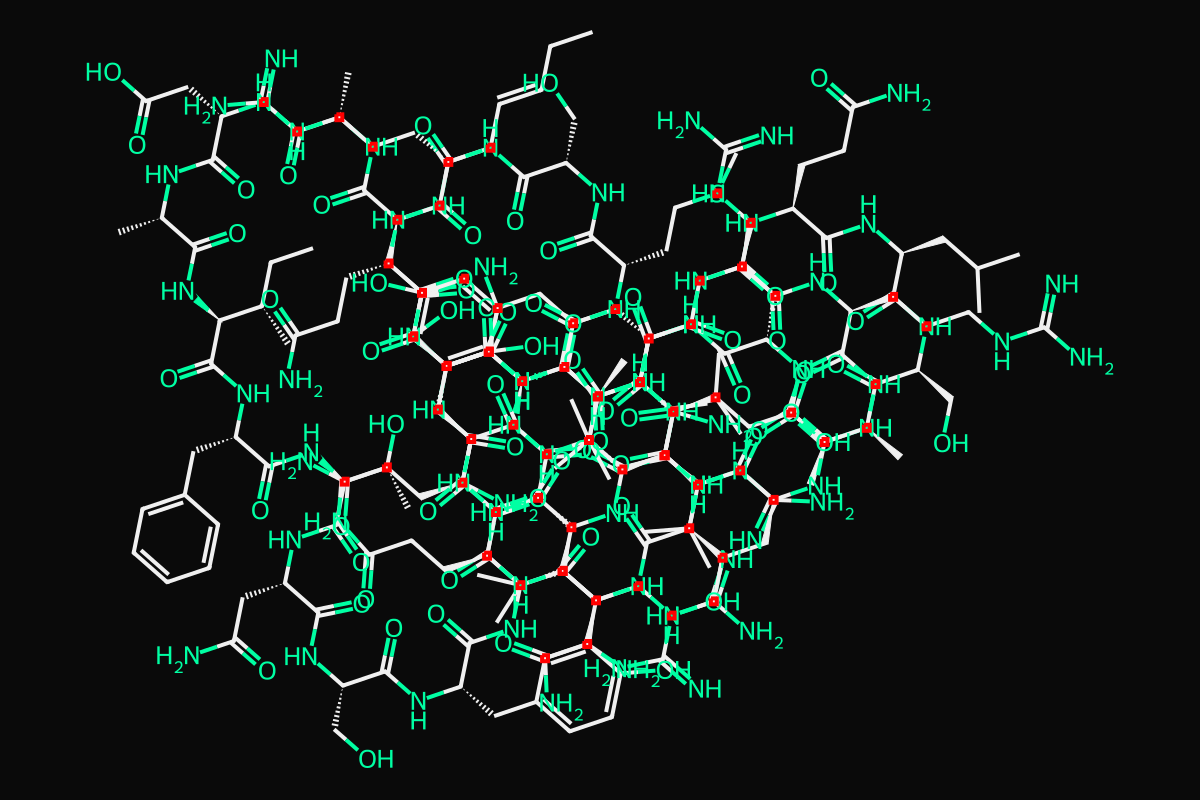
Tesamorelin is a synthetic analog of human growth-hormone-releasing hormone (GHRH, also called GRF). Structurally it is the full 44-amino-acid GHRH sequence with a trans-3-hexenoic acid group attached at the N-terminus, a modification that improves resistance to enzymatic breakdown relative to native GHRH. It acts on the GHRH receptor, which places it in the same mechanism family as CJC-1295, though it is a distinct and larger molecule.
| Attribute | Value |
|---|---|
| Common name | Tesamorelin |
| Class | Stabilized GHRH (GRF) analog |
| Structure | Full 44-residue human GHRH + N-terminal trans-3-hexenoyl group |
| Molecular formula | C₂₂₁H₃₆₆N₇₂O₆₇S (free base) |
| Molecular weight | ≈ 5135.9 g/mol (free base; ~5579 as the acetate) |
| CAS number | 218949-48-5 |
| Receptor target | GHRH receptor |
What does the research literature study?#
As a GHRH-receptor analog, tesamorelin is studied for its engagement of the GHRH receptor on the anterior pituitary and the resulting GH-axis signaling. Structured pharmacology references such as DrugBank (DB08869) and the NIH NCBI Bookshelf entry document its identity and mechanism as a GHRH analog. This profile addresses mechanism and chemistry only.
How it relates to CJC-1295#
Tesamorelin and CJC-1295 are both GHRH-receptor analogs, while Ipamorelin acts on the separate ghrelin / GHS receptor. The distinction between the two mechanism families is set out in the GH secretagogues cornerstone. The closest sibling compound, also a GHRH analog, is cataloged as CJC-1295 (DAC); see also the Ipamorelin profile for the contrasting ghrelin-receptor mechanism.
Handling and storage#
Tesamorelin is supplied as a lyophilized powder and dissolved before use. The reconstitution primer covers solvent selection, and the cold-chain article covers how storage stability changes once the material is reconstituted.
Frequently asked
- What is Tesamorelin?
- Tesamorelin is a synthetic stabilized analog of human growth-hormone-releasing hormone (GHRH): the full 44-residue GHRH sequence with an N-terminal trans-3-hexenoyl modification for stability. It acts on the GHRH receptor. It is handled here strictly as a laboratory research compound.
- How is Tesamorelin different from CJC-1295?
- Both are GHRH-receptor analogs, but they are distinct molecules. Tesamorelin is the full 44-residue GHRH sequence with a trans-3-hexenoyl N-terminal modification, while CJC-1295 is a shorter modified GHRH(1-29) fragment with four substitutions plus an albumin-binding DAC. They differ in length, structure, and persistence.
- What receptor does Tesamorelin act on?
- Tesamorelin acts on the GHRH receptor in the anterior pituitary, the same receptor family as CJC-1295. That is different from Ipamorelin, which acts on the ghrelin / GHS receptor.
Sources and further reading#
- Tesamorelin — DrugBank DB08869: structured pharmacology entry (mechanism, target, chemistry) for the GHRH analog tesamorelin.
- Tesamorelin — NCBI Bookshelf / LiverTox (NBK548730): NIH reference covering tesamorelin as a GHRH analog.
Last updated: 2026-05-27