

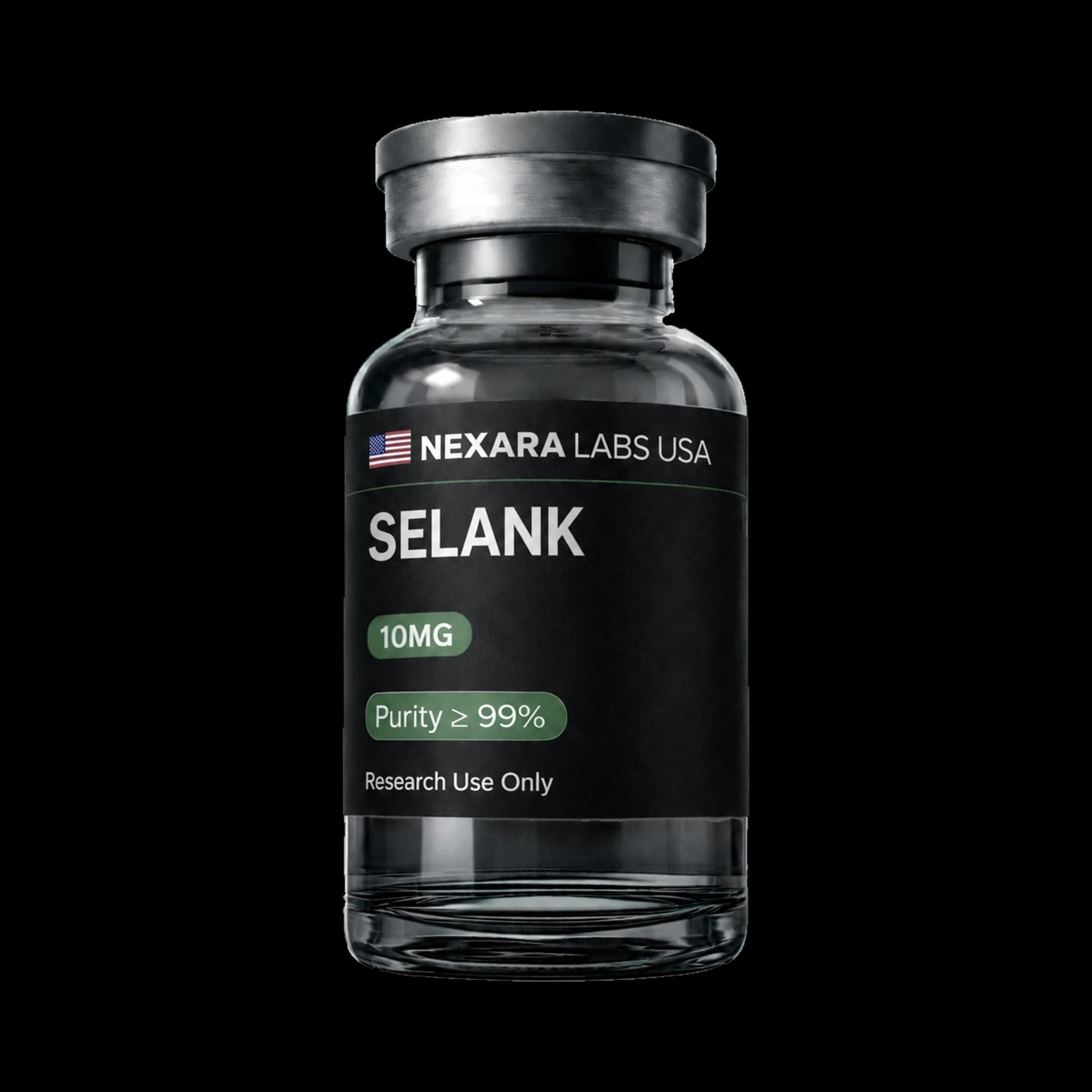
Selank
Selank
Strength
Research this compound
For research use only. Not for human consumption.
Identity, storage, and what ships.
The technical record. Identity rows reflect literature-cited values for this compound; storage rows describe the conditions under which Nexara holds and ships the lyophilized form.
Identity
- Appearance
- White lyophilized powder
- Molecular Formula
- C33H57N11O9
- Molecular Weight
- 751.88 g/mol
- CAS Number
- 129954-34-3
- Sequence
- Thr-Lys-Pro-Arg-Pro-Gly-Pro
- Synonyms
- Tuftsin analog
- Purity
- ≥99%
Storage profile
- Storage (Lyophilized)
- -20°C (long-term), 2-8°C up to 30 days (short-term)
- Storage (Reconstituted)
- 2-8°C
- Shelf Life (Lyophilized)
- 24 months at -20°C
- Shelf Life (Reconstituted)
- Up to 28 days at 2-8°C
- Reconstitution
- Bacteriostatic water (0.9% benzyl alcohol) for research reconstitution
- Handling
- Protect from direct light. Avoid repeated freeze-thaw cycles.
Shipment
- —1x lyophilized vial (10mg)
- —Certificate of Analysis (COA)
- —Proper storage instructions
Studied research areas.
Each item below names a domain in which Selank has been investigated in published research. Listed for context — not as a use recommendation.
- 01Regulatory neuropeptide signaling pathway research
- 02Tuftsin-derived peptide interaction studies
- 03Neurochemical regulatory process investigation
- 04Neural signaling network research
- 05Peptide-mediated regulatory communication studies
Held to research-grade quality standards.
Every batch is held to research-grade quality standards before it ships. Each vial is labeled with its batch identifier so that fulfillment can be traced through the order record. For our research-use-only posture, see the Research Compliance page.
Common questions for Selank.
For research use only. Not for human consumption.
These products are not intended to diagnose, treat, cure, or prevent any disease. They are sold strictly as research chemicals for laboratory use.
Fulfillment: Orders ship from Texas via USPS within 2 weeks of payment confirmation. You'll receive tracking by email when your package leaves our facility.
Researcher reviews
Reviews open as orders are delivered.
Only researchers who've received an order of this compound can submit a review. Submitted text is screened for compliant language before publication. No anonymous testimonials, no AI-generated copy.
Pending researcher reviews
Reviews appear here as researchers complete and verify orders.
If you've received this compound and would like to leave a review, the option appears in your account dashboard once your order ships.
Reference reading on Selank and adjacent topics.
- 2 min
Compound profile
Selank: Compound Profile
A research profile of Selank, a synthetic analog of the peptide tuftsin: identity, the GABAergic/regulatory mechanism, and what the CNS-signaling literature studies.
- 4 min
Foundational
Neuropeptides & Cognitive-Pathway Peptides: A Research Overview
How the nootropic neuropeptide class is studied: Semax (an ACTH-fragment analog) and Selank (a tuftsin analog), the CNS signaling pathways they engage, and how they differ.
- 5 min
Foundational
Metabolic, Incretin & Amylin Peptides: A Research Overview
How the metabolic peptide class is studied: incretin triple agonists (GLP-3), amylin analogs (Cagrilintide), and growth-hormone fragments (AOD9604), their receptor targets and research areas.
Related Research Products
Semax
10 mg · Neurological
Semax
10 mg
Semax is a synthetic regulatory peptide analog studied in laboratory environments for its interaction with neuropepti...
Cardiogen
20 mg · Neurological
Cardiogen
20 mg
Cardiogen is a synthetic tetrapeptide (Ala-Glu-Asp-Arg) that has been the subject of research into cardiomyocyte gene...
Cerebrolysin
60 mg · Neurological
Cerebrolysin
60 mg
Cerebrolysin is a low-molecular-weight neuropeptide preparation derived from purified porcine brain tissue that has b...
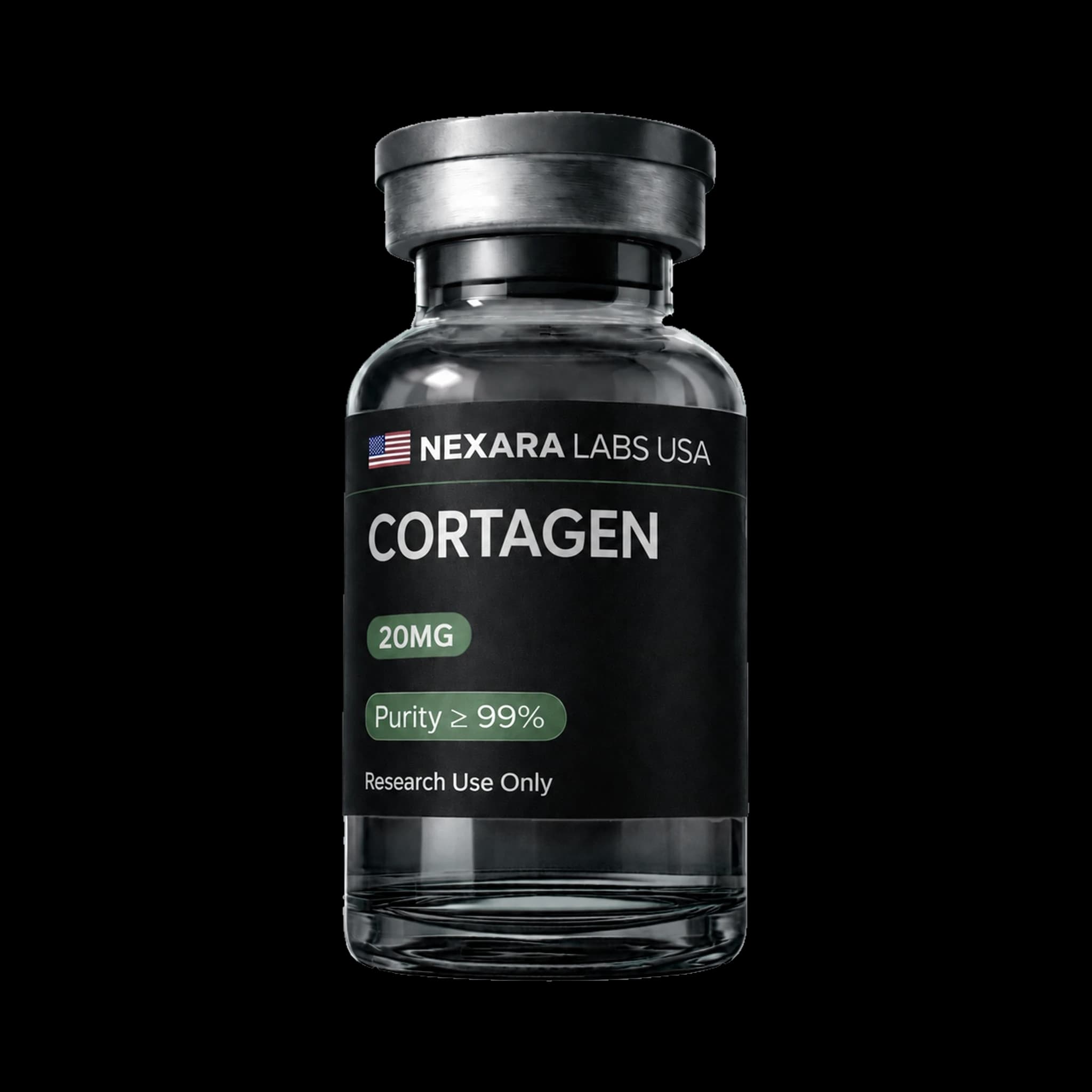
Cortagen
20 mg · Neurological
Cortagen
20 mg
Cortagen is a synthetic tetrapeptide (Ala-Glu-Asp-Pro) that has been the subject of research into neuroregulatory sig...