

On this page
AOD9604: Compound Profile
AOD9604 is the odd one out in the metabolic peptide class. It is not a receptor agonist but a structural fragment of a hormone, which gives it a different research story from GLP-3 and Cagrilintide. This profile covers its origin, what the literature studies, and how it relates to growth hormone. For the class, see the metabolic peptides overview.
What is AOD9604?#
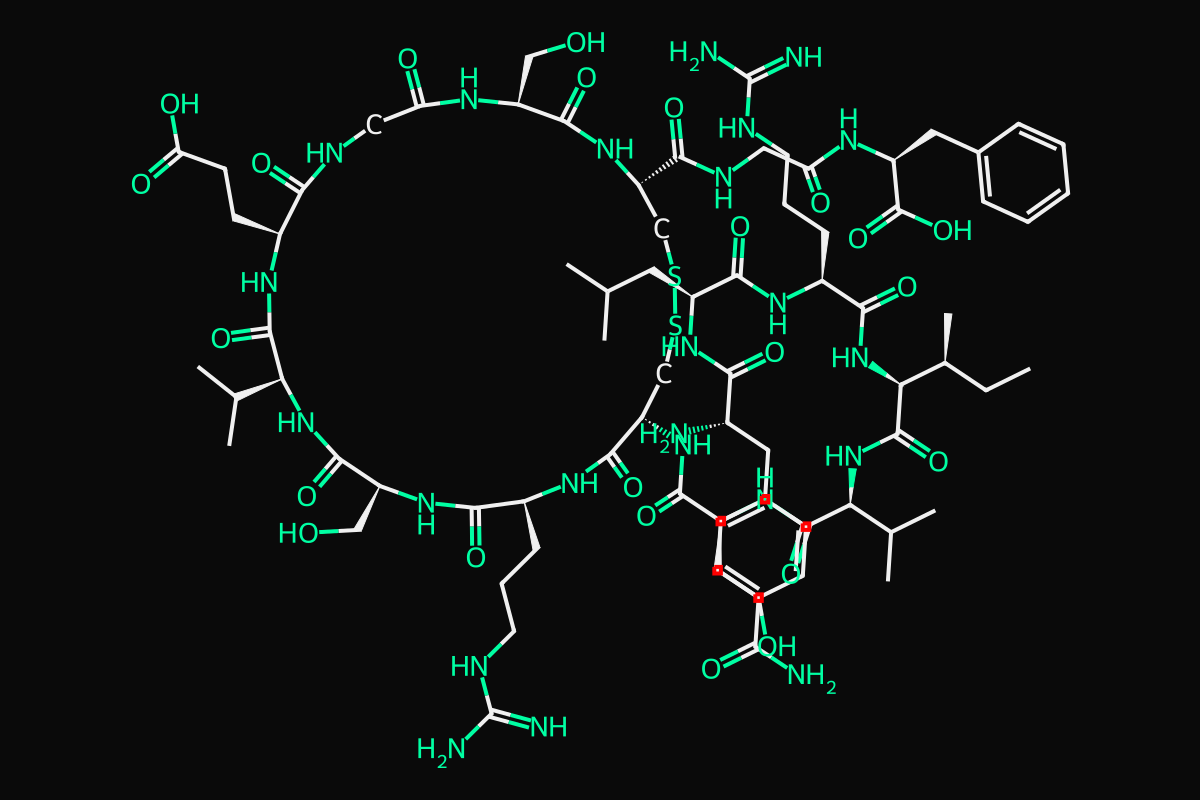
AOD9604 is a synthetic peptide based on the C-terminal region of human growth hormone, corresponding to roughly residues 176–191 of the hormone, with a tyrosine residue added at the N-terminus. It belongs to a line of research into so-called lipolytic fragments of growth hormone: short pieces of the molecule studied for activity attributed to that region, distinct from the full hormone's effects on growth and glucose signaling.
| Attribute | Value |
|---|---|
| Common name | AOD9604 (advanced obesity drug 9604) |
| Class | Synthetic growth-hormone C-terminal fragment |
| Origin | hGH C-terminal region (~residues 176–191) plus an N-terminal tyrosine |
| CAS number | 221231-10-3 |
| Molecular weight | ≈ 1815 g/mol (as commonly reported) |
| Primary study area | Lipid-metabolism research |
What does the research literature study?#
The research premise behind AOD9604 is that the lipid-metabolism activity associated with growth hormone may reside in its C-terminal region, and that a fragment of that region can be studied without the full hormone's wider signaling. The literature examines it in lipid-metabolism and adipose-research models. As a fragment rather than a receptor agonist, its mechanism is studied differently from the incretin and amylin compounds in its class. This is preclinical research and does not establish effects in people.
How it relates to the other metabolic peptides#
AOD9604 is a hormone fragment, while GLP-3 and Cagrilintide are receptor agonists on the incretin and amylin systems respectively. The three share the broad metabolic research area but have nothing in common mechanistically, which the metabolic peptides overview lays out in full.
Handling and storage#
AOD9604 arrives lyophilized and is dissolved before use. Storage practice matches the rest of the catalog: the reconstitution primer covers solvent choice, and the cold-chain article covers stability once the material is reconstituted.
Frequently asked
- What is AOD9604?
- AOD9604 is a synthetic peptide corresponding to the C-terminal region of human growth hormone (around residues 176–191) with an added N-terminal tyrosine. The literature studies it for lipid-metabolism activity attributed to that fragment, separate from the full hormone's broader signaling. It is a laboratory research compound and is not for human use.
- Is AOD9604 the same as growth hormone?
- No. It is a short fragment of the growth-hormone molecule, not the full hormone. The research premise is that the lipid-metabolism activity associated with growth hormone can be studied through this C-terminal fragment without the full hormone's wider signaling. They are related but distinct.
- How does AOD9604 differ from GLP-3 and Cagrilintide?
- AOD9604 is a structural fragment of a hormone, whereas GLP-3 and Cagrilintide are receptor agonists (on the incretin and amylin systems respectively). All three appear in metabolic research, but AOD9604 has a fundamentally different mechanism story as a fragment rather than an agonist.
Sources and further reading#
- Ng et al., Metabolic studies of a synthetic lipolytic domain (AOD9604) of human growth hormone, Horm Res 2000 (PMID 11146367): the primary metabolic study of the AOD9604 C-terminal GH fragment.
Last updated: 2026-05-27