

On this page
Cagrilintide: Compound Profile
Cagrilintide is the amylin member of the metabolic peptide class, mechanistically separate from the incretin agonists it is often studied alongside. This profile covers its receptor target, the structural feature behind its long half-life, and its research areas. For where it sits in the class, see the metabolic peptides overview.
What is Cagrilintide?#
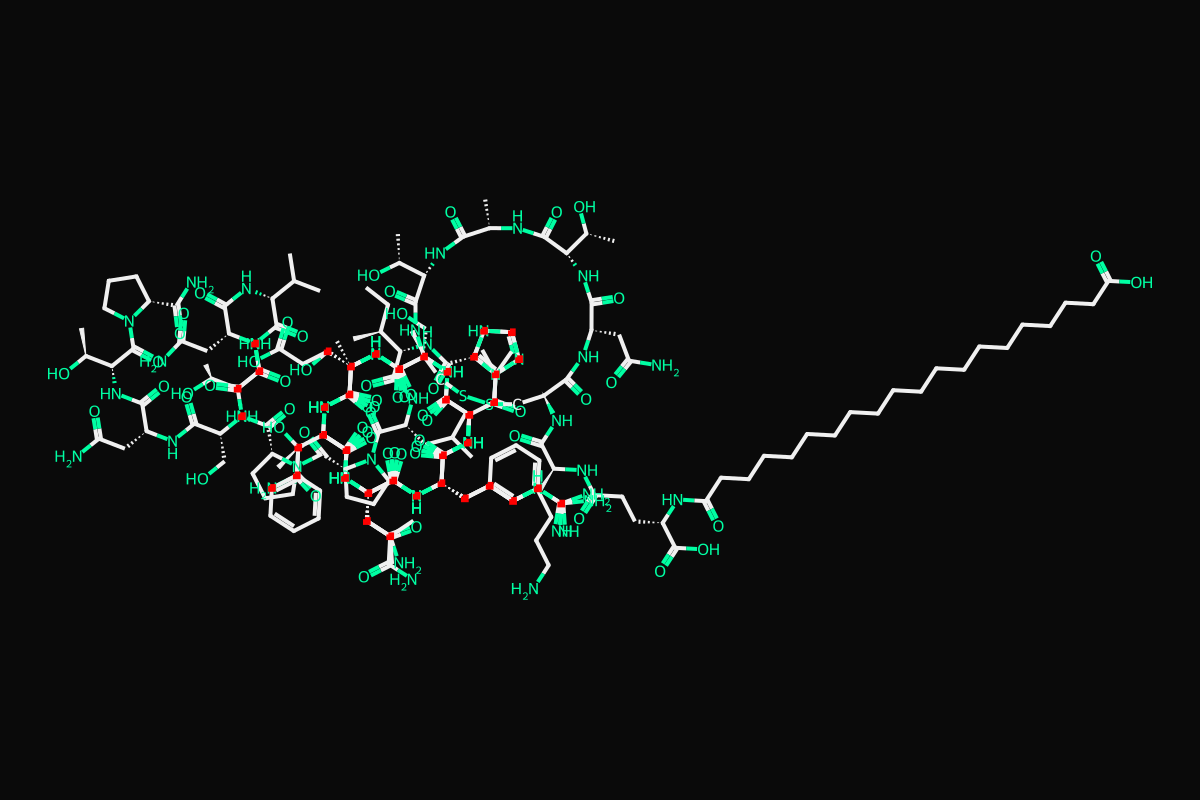
Cagrilintide is a synthetic, long-acting analog of amylin (also called islet amyloid polypeptide), a hormone co-secreted with insulin from pancreatic beta cells. It binds amylin and calcitonin receptor complexes, and a lipidation modification together with sequence changes gives it stability in solution and a long circulating half-life. Structural work using cryo-electron microscopy has characterized how it engages the amylin receptor subtypes.
| Attribute | Value |
|---|---|
| Common name | Cagrilintide (long-acting amylin analog) |
| Class | Amylin-receptor agonist; lipidated peptide analog |
| Receptor targets | Amylin (AMY1/2/3) and calcitonin receptor complexes |
| Reported half-life | ≈ 7 days (supports once-weekly research dosing schedules) |
| Key structural feature | Lipid modification + sequence changes for stability |
What does the research literature study?#
Cagrilintide is studied for activity at brainstem amylin receptors, where work in animal models reports that it lowers body weight through amylin receptors AMY1R and AMY3R. The pharmacology literature documents slowed gastric emptying and suppression of postprandial glucagon as part of its satiety-pathway profile, with the medicinal-chemistry development of the analog accounting for its long half-life. This is preclinical and pharmacology research; it does not establish outcomes in people.
How it relates to the incretin agonists#
Cagrilintide acts on amylin and calcitonin receptors. The incretin triple agonist GLP-3 acts on the GLP-1, GIP, and glucagon receptors, a separate system. Because the two pathways are independent, the literature studies amylin analogs and incretin agonists both individually and in combination. The mechanism contrast is developed in the metabolic peptides overview.
Handling and storage#
Cagrilintide is provided as a lyophilized powder and reconstituted prior to use. Its lipidation gives it good solution stability, but handling is standard for the catalog: the reconstitution primer covers solvent choice, and the cold-chain article covers stability once reconstituted.
Frequently asked
- What is Cagrilintide?
- Cagrilintide is a long-acting synthetic analog of amylin, a hormone co-secreted with insulin. It acts on amylin and calcitonin receptor complexes and is studied in satiety-pathway and energy-balance research. A lipid modification gives it a reported half-life near seven days. It is a laboratory research compound and is not for human use.
- What receptors does Cagrilintide act on?
- It acts on amylin receptor complexes (AMY1, AMY2, AMY3) and calcitonin receptors, primarily in brainstem regions. This is a different receptor system from the incretin receptors that GLP-3 engages, which is why the two compounds are mechanistically distinct despite a shared research area.
- Why does Cagrilintide have such a long half-life?
- A lipidation modification, together with sequence changes that confer solution stability, extends its circulating half-life to a reported seven days, which is why research dosing schedules for it are typically once-weekly. The medicinal-chemistry work behind the analog documents these modifications.
Sources and further reading#
- Cagrilintide lowers body weight through brain amylin receptors AMY1R and AMY3R (PMC12270663): receptor-mechanism study in animal models.
- Development of Cagrilintide, a long-acting amylin analogue, J Med Chem 2021 (doi:10.1021/acs.jmedchem.1c00565): medicinal-chemistry account of the analog and its half-life.
Last updated: 2026-05-27