

On this page
BPC-157: Compound Profile
BPC-157 (Body Protection Compound-157) is among the most-studied peptides in the tissue-repair research class. This profile sets out what it is at the molecular level, the mechanism the literature attributes to it, and the research areas where it appears, all as laboratory-research context. For how it sits alongside the other compounds in its class, see the tissue-repair peptides overview.
What is BPC-157?#
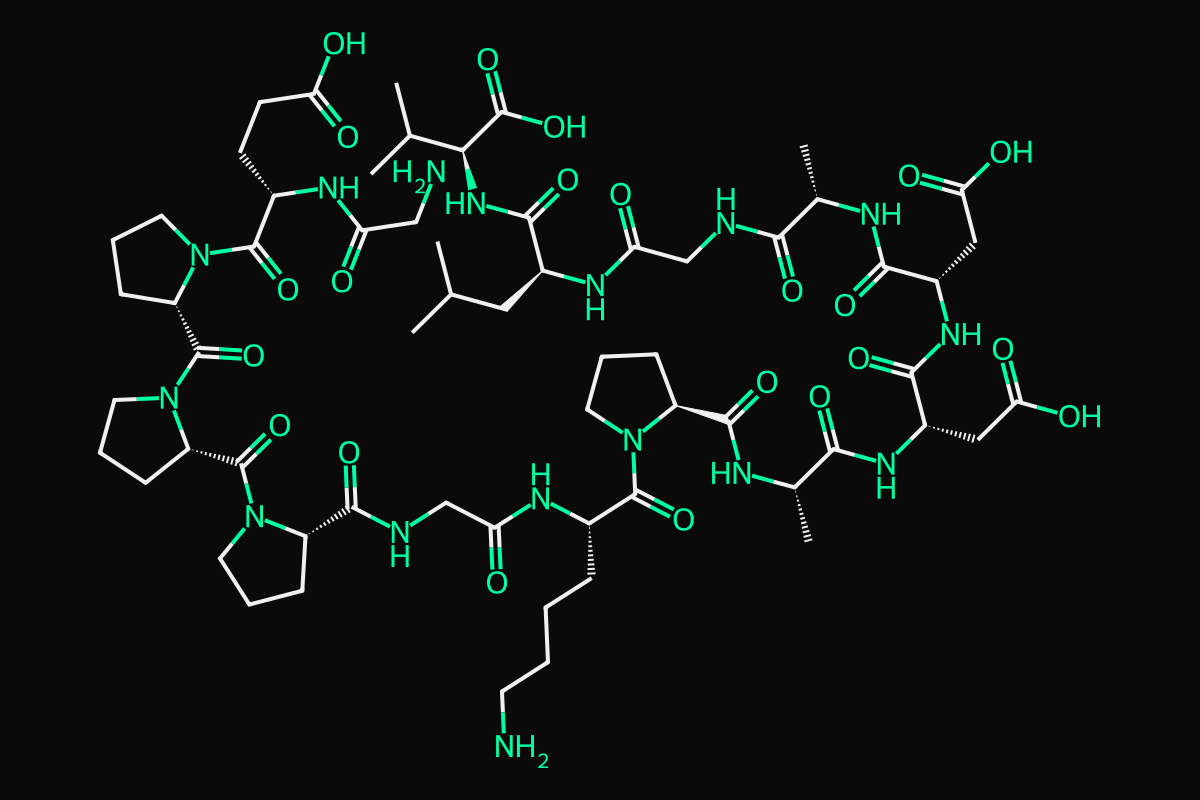
BPC-157 is a stable pentadecapeptide: a chain of 15 amino acids whose sequence matches a fragment of a larger protein (Body Protection Compound) identified in human gastric juice. Predrag Sikiric and colleagues at the University of Zagreb first characterized it in 1993. One property recurs throughout its literature, which is its unusual stability in gastric juice, where it stays intact far longer than most peptides do.
| Attribute | Value |
|---|---|
| Common name | BPC-157 (Body Protection Compound-157) |
| Peptide class | Synthetic pentadecapeptide (15 amino acids) |
| Sequence | Gly-Glu-Pro-Pro-Pro-Gly-Lys-Pro-Ala-Asp-Asp-Ala-Gly-Leu-Val (GEPPPGKPADDAGLV) |
| Molecular formula | C₆₂H₉₈N₁₆O₂₂ |
| Molecular weight | ≈ 1419.5 g/mol |
| CAS number | 137525-51-0 |
| Origin | Fragment of a protein in gastric juice; characterized 1993 (Univ. Zagreb) |
What does the research literature study?#
The BPC-157 preclinical record runs to well over a hundred peer-reviewed papers, most of them from the originating Zagreb group, and it centers on cytoprotection and angiogenic signaling. The most frequently cited mechanism is upregulation of vascular endothelial growth factor signaling (VEGFR2) together with modulation of the nitric-oxide system. Study areas include tendon and ligament models, gastrointestinal and vascular models, and a wider range of organ systems. One caveat frames all of it: this is preclinical work in cell culture and animal models, and it does not speak to effects in humans.
Where BPC-157 sits in the tissue-repair class#
BPC-157 and TB-500 are studied side by side, yet they act on separate targets: BPC-157 on protective and angiogenic signaling, TB-500 on actin regulation and cell migration. That separation is why the two are often examined in combination, and why they appear together in multi-peptide research blends such as Wolverine (BPC-157 with TB-500) and the four-compound KLOW. The full head-to-head is in BPC-157 vs TB-500.
Handling and storage#
BPC-157 arrives as a lyophilized powder and is dissolved before use. Two references cover the practical side: the reconstitution primer on solvent choice and aggregation risk, and the cold-chain article on how lyophilized and reconstituted material differ in storage stability.
Frequently asked
- What is BPC-157?
- BPC-157 is a synthetic 15-amino-acid peptide (sequence GEPPPGKPADDAGLV) that corresponds to a fragment of a protein found in gastric juice, first characterized in 1993. Research studies it for cytoprotective and angiogenic signaling. It is a laboratory research compound and is not for human use.
- What is the reported mechanism of BPC-157?
- The mechanism cited most often in the preclinical literature is upregulation of vascular endothelial growth factor signaling (VEGFR2) alongside modulation of the nitric-oxide system. That activity has been examined across tendon, ligament, gastrointestinal, and vascular models. The work is preclinical and does not demonstrate effects in humans.
- What is the molecular weight and formula of BPC-157?
- BPC-157 is commonly reported with the molecular formula C₆₂H₉₈N₁₆O₂₂, a molecular weight near 1419.5 g/mol, and CAS number 137525-51-0. It is a pentadecapeptide of 15 amino acids in the sequence GEPPPGKPADDAGLV.
Sources and further reading#
- Sikiric et al., Stable Gastric Pentadecapeptide BPC 157 — cytoprotection/organoprotection review (PMC7096228): foundational review of the BPC-157 preclinical record.
- BPC 157 pleiotropic beneficial activity review (PMC11053547): survey of reported BPC-157 activity across organ systems and signaling pathways.
Last updated: 2026-05-27