

On this page
TB-500: Compound Profile
TB-500 is studied alongside BPC-157 in the tissue-repair class, but its mechanism is structural where BPC-157's is signaling. This profile covers what it is relative to its parent protein, the mechanism the literature attributes to it, and its research areas. For its place in the wider class, see the tissue-repair peptides overview.
What is TB-500?#
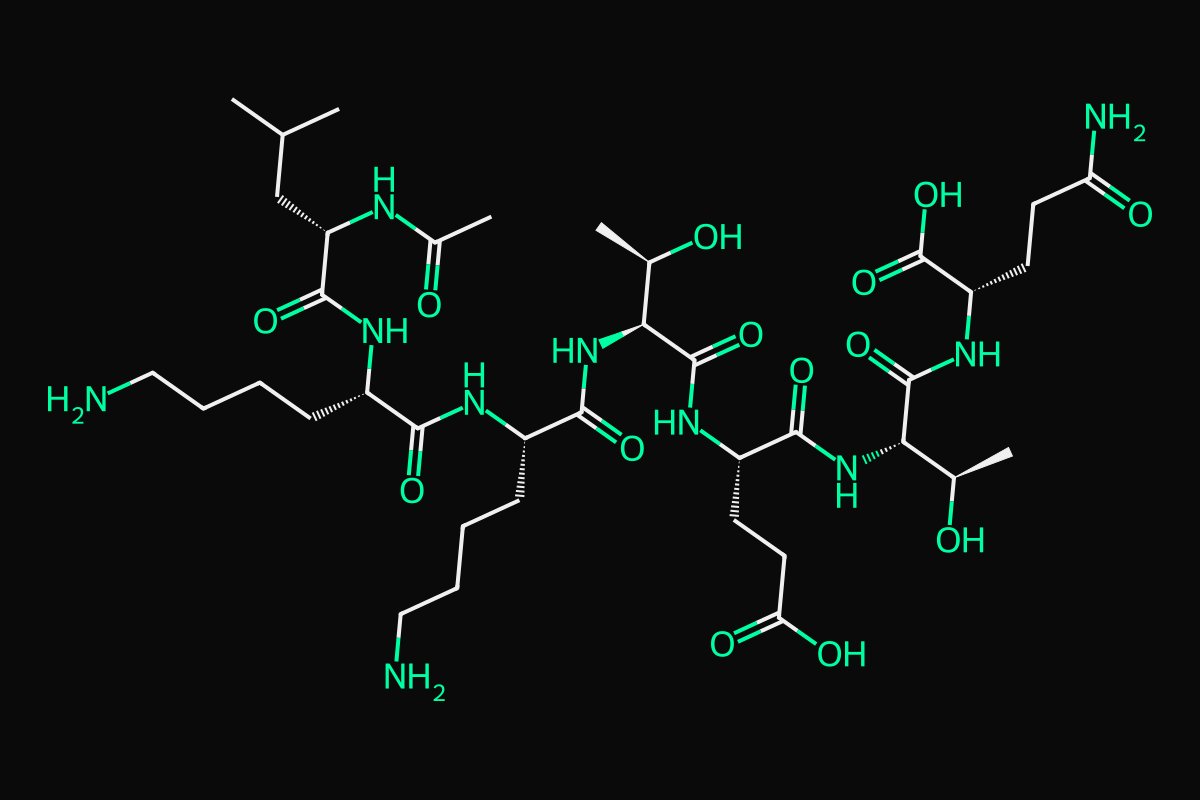
TB-500 is a synthetic peptide derived from the actin-binding region of thymosin β4 (Tβ4), a 43-residue protein that is the main actin-sequestering molecule in many cell types. In research catalogs, the name "TB-500" refers to this Tβ4-derived peptide. Sources differ on whether a given product is the full-length protein or a shorter active fragment, so standalone CAS and molecular-weight figures vary between suppliers. That is why the reliable identity anchor here is the parent protein itself rather than a single quoted mass.
| Attribute | Value |
|---|---|
| Common name | TB-500 (thymosin β4–derived peptide) |
| Peptide class | Synthetic peptide based on the actin-binding region of thymosin β4 |
| Parent protein | Thymosin β4 (Tβ4) — UniProt P62328, gene TMSB4X |
| Parent length | 43 amino acids |
| Parent sequence | SDKPDMAEIEKFDKSKLKKTETQEKNPLPSKETIEQEKQAGES |
| Key actin-binding motif | The LKKTETQ region |
| Reported target | G-actin sequestration; actin-cytoskeleton dynamics |
What does the research literature study?#
Thymosin β4 binds monomeric (G-)actin and regulates the pool available for filament assembly, a mechanism worked out in detail by cryo-structural and biochemical studies. Since actin dynamics drive cell movement, the TB-500 literature concentrates on cell migration, angiogenesis, and wound-closure models. The actin-sequestering behavior of Tβ4 and its fragments is the experimental basis for studying the shorter TB-500 peptide. As across the class, this is preclinical research and does not speak to human effects.
Where TB-500 sits in the tissue-repair class#
TB-500 acts on the cytoskeleton (actin regulation, cell migration) while BPC-157 acts on protective and angiogenic signaling. Their pathways do not overlap, which is why the literature studies them together and why both appear in multi-peptide research blends such as Wolverine (TB-500 with BPC-157) and the four-compound KLOW. The full head-to-head is in BPC-157 vs TB-500; BPC-157 has its own compound profile.
Handling and storage#
TB-500 is supplied as a lyophilized solid and dissolved prior to use. For the practical details, the reconstitution primer addresses solvent selection and aggregation, while the cold-chain article addresses how storage stability changes once the powder is in solution.
Frequently asked
- What is TB-500?
- TB-500 is a synthetic peptide based on the actin-binding region of thymosin β4, a 43-residue protein that is the main G-actin–sequestering molecule in many cell types. Research studies it for actin-cytoskeleton regulation and cell migration. It is a laboratory research compound and is not for human use.
- Is TB-500 the same as thymosin beta-4?
- They are closely related but not identical. Thymosin β4 (UniProt P62328) is the full 43-residue parent protein, and TB-500 is the synthetic peptide research catalogs derive from its active actin-binding region. Because suppliers differ on whether a given TB-500 is the full protein or a shorter fragment, its standalone CAS and molecular weight are reported inconsistently.
- What does the research on TB-500 study?
- The literature focuses on cell migration, angiogenesis, and wound-closure models, all driven by the actin-regulating mechanism of its parent protein thymosin β4. This work is preclinical, conducted in cell culture and animal models, and does not demonstrate effects in humans.
Sources and further reading#
- Thymosin beta-4, UniProt P62328: canonical sequence and annotation for the parent protein of TB-500.
- Structural basis of thymosin-β4/profilin exchange in actin polymerization, PNAS (PMC4217450): structural account of how thymosin β4 sequesters G-actin.
- Actin-sequestering ability of thymosin β4 and its fragments (PMID 8471179): primary characterization of the actin-binding behavior relevant to TB-500.
Last updated: 2026-05-27