

On this page
Sermorelin Acetate: Compound Profile
Sermorelin is the reference point for the GHRH-analog branch of the growth-hormone secretagogue class: the unmodified bioactive core that the longer-acting analogs are engineered from. This profile covers what it is relative to its parent hormone, how it differs from the stabilized analogs, and what the literature studies. For its place in the wider class, see the growth-hormone secretagogues overview.
What is Sermorelin Acetate?#
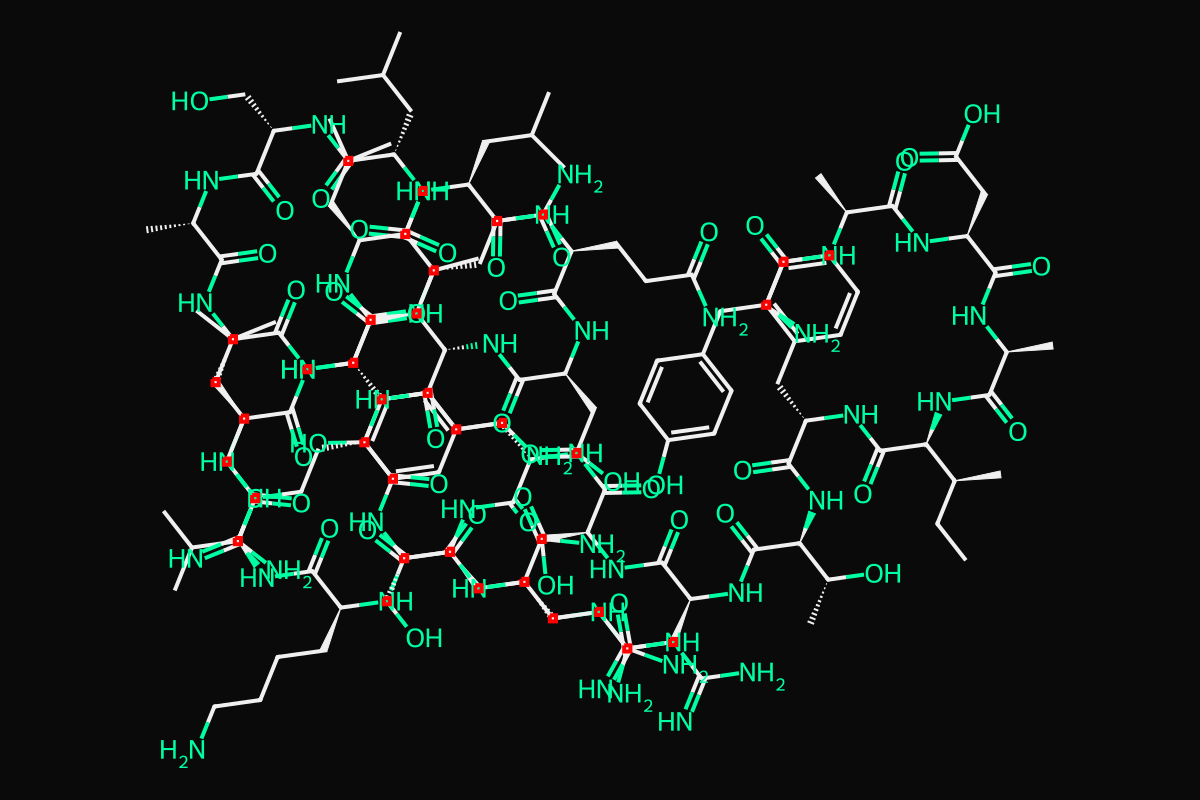
Sermorelin is a synthetic analog of the first 29 residues of growth-hormone-releasing hormone, GHRH(1-29)-NH2, the bioactive N-terminal core of the parent hormone somatoliberin. Structure-activity work established that this 29-residue amide is the shortest fragment that retains the full biological activity of the native 44-residue hormone, which is why sermorelin is treated as the baseline GHRH analog. The acetate refers to the salt form supplied in research catalogs: sermorelin is a peptide base handled as its acetate salt for stability and solubility. Crucially, it carries none of the substitutions or tethers that stabilize the engineered analogs, so it is degraded rapidly, closest of the class to the native, short-lived GHRH pulse.
| Attribute | Value |
|---|---|
| Common name | Sermorelin (acetate salt); GHRH(1-29)-NH2 |
| Class | Unmodified GHRH(1-29) analog (GRF fragment) |
| Parent hormone | GHRH / somatoliberin — UniProt P01286, gene GHRH |
| Base structure | First 29 residues of GHRH, C-terminal amide; no stabilizing substitutions |
| Molecular formula | C₁₄₉H₂₄₆N₄₄O₄₂S (free base) |
| CAS number | 86168-78-7 (free base); supplied as the acetate salt |
| Reported persistence | Minutes (rapid enzymatic clearance) |
| Reported target | GHRH receptor on the anterior pituitary |
How does it differ from CJC-1295 and tesamorelin?#
All three are GHRH-receptor analogs, but sermorelin is the unmodified template and the other two are stabilized derivatives of it. Sermorelin is bare GHRH(1-29)-NH2 with no changes to resist enzymatic breakdown, so it clears in minutes. CJC-1295 takes the same 1-29 core, adds four amino-acid substitutions for stability, and (in the DAC form) an albumin tether that extends persistence to a reported 6–8 days. Tesamorelin instead uses the full 44-residue GHRH sequence with an N-terminal trans-3-hexenoyl group. The practical distinction is duration of receptor engagement: sermorelin models a short, native-like pulse, while the modified analogs model sustained signaling. The full profiles are at CJC-1295 No DAC and Tesamorelin.
What does the research literature study?#
Sermorelin binds the GHRH receptor on anterior-pituitary somatotrophs, the same receptor family as CJC-1295 and tesamorelin. Structure-activity studies of hGHRH(1-29)-NH2 map which residues drive receptor binding and define sermorelin as the minimal fully active fragment, while pharmacokinetic characterization of GHRH(1-29)-NH2 documents its rapid plasma clearance and the resulting short, pulse-like signaling. Because it clears quickly, the literature often pairs it conceptually with a ghrelin-receptor secretagogue such as Ipamorelin, which acts on a separate receptor. As across the class, this is preclinical research framing and does not speak to human effects.
Where Sermorelin sits in the secretagogue class#
Sermorelin, CJC-1295, and tesamorelin are all GHRH-receptor analogs, while ghrelin-mimetic secretagogues such as Ipamorelin act on the separate GHS receptor. The pathways are distinct, which is why the literature studies GHRH analogs and ghrelin mimetics as complementary rather than interchangeable. The receptor-level comparison is laid out in CJC-1295 vs Ipamorelin.
Handling and storage#
Sermorelin acetate is supplied as a lyophilized solid and dissolved prior to use. The reconstitution primer addresses solvent selection and aggregation, and the cold-chain article addresses how storage stability changes once the powder is in solution.
Frequently asked
- What is Sermorelin Acetate?
- Sermorelin is the synthetic GHRH(1-29)-NH2 peptide: the first 29 residues of growth-hormone-releasing hormone as a C-terminal amide, handled as its acetate salt. It is the shortest fragment that retains the full activity of native GHRH and acts on the GHRH receptor. It is a laboratory research compound and is not for human use.
- How is Sermorelin different from CJC-1295?
- Both are built on the GHRH(1-29) core, but sermorelin is unmodified while CJC-1295 adds four stabilizing amino-acid substitutions and, in the DAC form, an albumin tether. Sermorelin clears within minutes; CJC-1295 with DAC is reported to persist for 6–8 days. Sermorelin is studied for short, native-like GHRH-receptor signaling.
- What receptor does Sermorelin act on?
- Sermorelin acts on the GHRH receptor on anterior-pituitary somatotrophs, the same receptor family as CJC-1295 and tesamorelin. That is different from Ipamorelin, which acts on the separate ghrelin / GHS receptor.
Sources and further reading#
- Somatoliberin (GHRH), UniProt P01286: canonical sequence and annotation for the parent hormone whose 1-29 core sermorelin reproduces.
- Human growth hormone-releasing hormone hGHRH(1-29)-NH2: systematic structure-activity relationship studies (PMID 9513600): SAR study defining the 29-residue amide as the minimal fully active GHRH fragment.
- Pharmacokinetics of growth hormone-releasing hormone(1-29)-NH2 and stimulation of growth hormone secretion (PMID 8329825): characterization of the rapid clearance and GH-axis signaling of the GHRH(1-29)-NH2 peptide.
Last updated: 2026-08-13