

On this page
CJC-1295 No DAC: Compound Profile
CJC-1295 comes in two research forms distinguished by a single structural feature: the presence or absence of the DAC albumin tether. The No DAC form is the short-acting one. This profile covers what it is relative to its parent hormone, how it differs from the DAC version, and what the literature studies. For its place in the wider class, see the growth-hormone secretagogues overview.
What is CJC-1295 No DAC?#
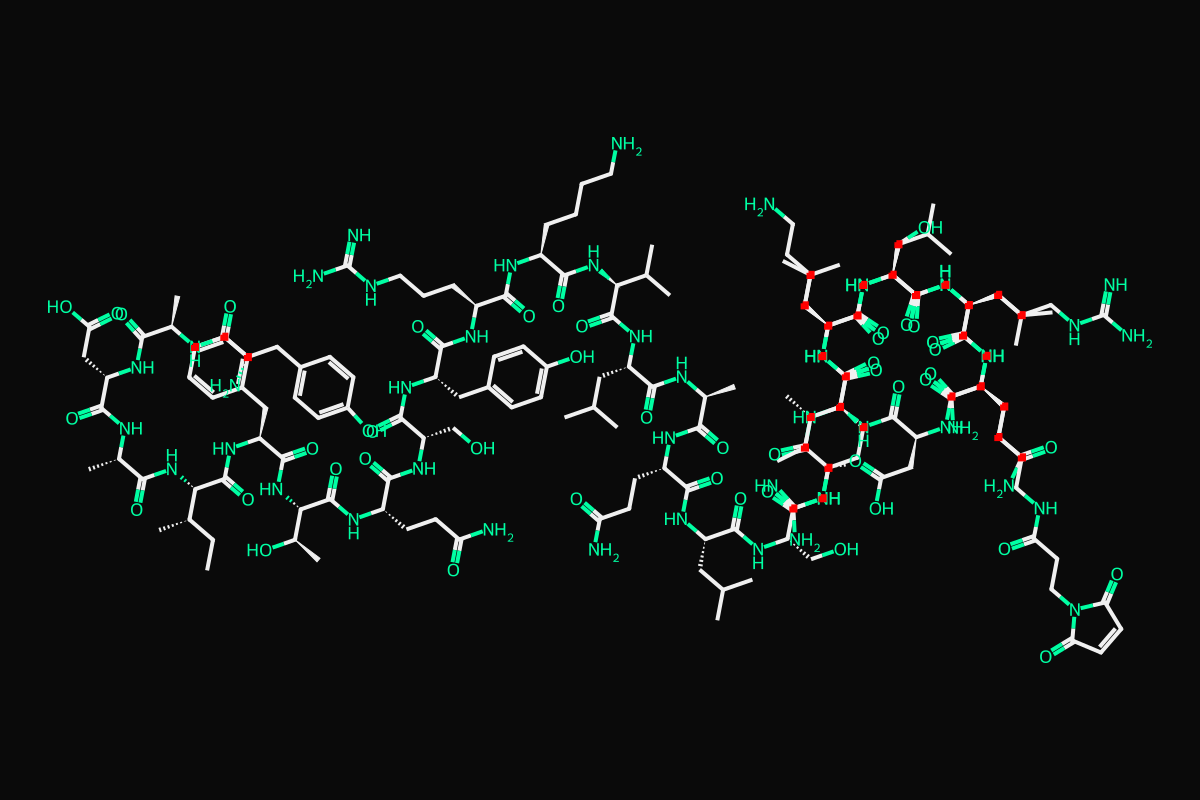
CJC-1295 No DAC is a synthetic analog of the first 29 residues of growth-hormone-releasing hormone, GHRH(1-29), the bioactive core of the parent hormone somatoliberin. It carries the same four amino-acid substitutions as the DAC version, which are what make it resistant to enzymatic breakdown. The defining difference is what it lacks: there is no maleimido-lysine Drug Affinity Complex at the C-terminus. Without that albumin-binding group, the peptide is not tethered to serum protein and clears on the order of minutes rather than days. In research catalogs this form is also listed as "Modified GRF 1-29," and it sits within the broader family of synthetic GHRH analogs catalogued in the analytical literature.
| Attribute | Value |
|---|---|
| Common name | CJC-1295 No DAC (Modified GRF 1-29) |
| Class | Short-acting GHRH(1-29) analog |
| Parent hormone | GHRH / somatoliberin — UniProt P01286, gene GHRH |
| Base structure | GRF(1-29) with 4 stabilizing substitutions, no DAC |
| Distinguishing feature | No maleimido-lysine albumin tether (the DAC group is absent) |
| CAS number (as catalogued) | 863288-34-0 (Modified GRF 1-29, without DAC) |
| Reported persistence | Minutes (short-acting), vs a reported ~6–8 days for the DAC form |
| Reported target | GHRH receptor on the anterior pituitary |
How does it differ from CJC-1295 with DAC?#
The only structural difference is the Drug Affinity Complex, and it changes the pharmacokinetics entirely. The DAC form carries a maleimido-lysine group that bonds covalently to a free thiol on serum albumin, tethering the peptide so it persists for a reported 6–8 days. The No DAC form omits that group, so the same stabilized GHRH(1-29) backbone clears within minutes. The foundational pharmacology of the long-acting DAC analog was documented by Teichman and colleagues (2006); the No DAC form is studied as the short-acting counterpart, closer in kinetics to the natural, short-lived GHRH pulse. The full compound profile for the long-acting form is at CJC-1295 (DAC).
What does the research literature study?#
Like the DAC form, CJC-1295 No DAC binds the GHRH receptor on the anterior pituitary. Because it clears quickly, the literature frames it around short, pulse-like receptor engagement rather than the sustained signaling that defines the DAC version. The short-lived kinetics of the unconjugated GHRH(1-29) scaffold were characterized early for GRF(1-29)-NH2, whose rapid clearance is the baseline the four stabilizing substitutions were designed to extend without adding an albumin tether. That short-duration profile is why the No DAC form is often studied together with a ghrelin-receptor secretagogue such as Ipamorelin, a compound with its own documented pharmacokinetic-pharmacodynamic profile that acts on a separate receptor: the two engage complementary pathways. As across the class, this is preclinical research framing and does not speak to human effects.
Where CJC-1295 No DAC sits in the secretagogue class#
CJC-1295 (in either form) is a GHRH-receptor analog, while ghrelin-mimetic secretagogues such as Ipamorelin act on the separate GHS receptor. The pathways are distinct, which is why the literature studies GHRH analogs and ghrelin mimetics as complementary rather than interchangeable. The receptor-level comparison is laid out in CJC-1295 vs Ipamorelin.
Handling and storage#
CJC-1295 No DAC is supplied as a lyophilized solid and dissolved prior to use. The reconstitution primer addresses solvent selection and aggregation, and the cold-chain article addresses how storage stability changes once the powder is in solution.
Frequently asked
- What is CJC-1295 No DAC?
- It is a synthetic analog of GHRH(1-29) with four amino-acid substitutions for enzymatic stability but no Drug Affinity Complex, also listed as Modified GRF 1-29. Without the albumin-binding DAC group it clears in minutes, so research studies it for short, pulse-like GHRH-receptor signaling. It is a laboratory research compound and is not for human use.
- What is the difference between CJC-1295 with and without DAC?
- The difference is the maleimido-lysine Drug Affinity Complex. With DAC, the peptide binds serum albumin and persists for a reported 6–8 days; without DAC, the same stabilized GHRH(1-29) backbone clears within minutes. The No DAC form is studied for short-duration signaling closer to a natural GHRH pulse, while the DAC form is studied for sustained signaling.
- Is CJC-1295 No DAC the same as Modified GRF 1-29?
- Yes. "Modified GRF 1-29" is the common alternate name for the No DAC form: a GRF(1-29) sequence carrying the four stabilizing substitutions but lacking the DAC albumin tether. Both names refer to the same short-acting research compound.
Sources and further reading#
- Somatoliberin (GHRH), UniProt P01286: canonical sequence and annotation for the parent hormone whose 1-29 core CJC-1295 analogs are based on.
- Teichman et al., Prolonged GH/IGF-I secretion by CJC-1295, J Clin Endocrinol Metab 2006 (PMID 16352683): foundational pharmacology study of the long-acting CJC-1295 analog, establishing the DAC-driven persistence that the No DAC form deliberately lacks.
- Wilton et al., Pharmacokinetics of GHRH(1-29)-NH2, Acta Paediatr Suppl 1993 (PMID 8329825): characterization of the rapid clearance of the unmodified GHRH(1-29) scaffold, the short-acting baseline the CJC-1295 substitutions extend.
- Gobburu et al., PK-PD modeling of ipamorelin, Pharm Res 1999 (PMID 10496658): pharmacokinetic-pharmacodynamic profile of the ghrelin-receptor secretagogue often co-studied with GHRH analogs on the complementary pathway.
- Memdouh et al., Advances in the detection of GHRH synthetic analogs, Drug Test Anal 2021 (PMID 34665524): analytical review situating CJC-1295 and Modified GRF 1-29 within the family of synthetic GHRH analogs.
Last updated: 2026-08-13