

On this page
DSIP: Compound Profile
DSIP is one of the older and more enigmatic members of the neuropeptide class — its sequence has been known since the 1970s, yet its precise receptor and mechanism remain unsettled in the literature. This profile covers what it is, the delta-EEG activity the research attributes to it, and where it sits among the nootropic-adjacent neuropeptides. For the wider class, see the neuropeptides overview.
What is DSIP?#
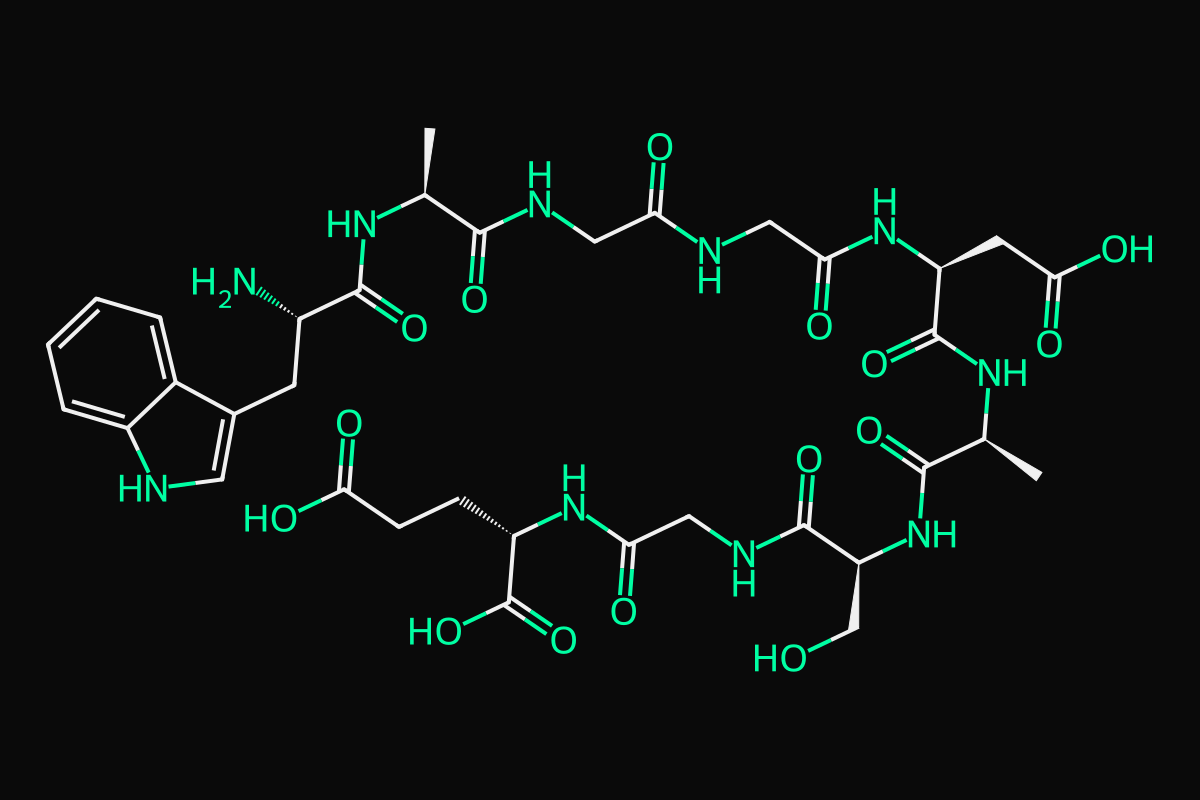
DSIP, or delta sleep-inducing peptide, is a naturally occurring nonapeptide with the sequence Trp-Ala-Gly-Gly-Asp-Ala-Ser-Gly-Glu and a molecular weight near 849 daltons. It was identified by Guido Schoenenberger and Marcel Monnier at the University of Basel, who recovered it from the extracorporeal dialysate of cerebral venous blood taken from rabbits whose intralaminar thalamus was electrically stimulated into a delta-wave EEG state. Its amino-acid sequence, chemical synthesis, and activity were reported in 1978. The name records the electrophysiological state it was associated with, not an established function in any organism.
| Attribute | Value |
|---|---|
| Common name | DSIP (delta sleep-inducing peptide) |
| Class | Naturally occurring linear nonapeptide |
| Sequence | Trp-Ala-Gly-Gly-Asp-Ala-Ser-Gly-Glu (WAGGDASGE) |
| Molecular formula | C₃₅H₄₈N₁₀O₁₅ |
| Approximate molecular weight | ~848.8 Da |
| PubChem CID | 68816 |
| First isolated | Rabbit cerebral venous blood (Schoenenberger–Monnier, Basel) |
| Primary study area | Delta-EEG sleep-architecture and neuroendocrine signaling research |
What does the research literature study?#
The DSIP literature concentrates on the delta-wave EEG state it was named for, and on a broad set of neuroendocrine signaling observations reported across decades of animal work. The original characterization established the nonapeptide sequence and confirmed that synthetic material reproduced the reported delta-EEG activity, which is why the synthetic peptide is what research catalogs supply. Later preclinical work broadened the scope to circadian, stress-axis, and CNS-signaling questions: rodent studies have examined the peptide in restraint-stress models and in sleep-architecture and CREB-pathway models under hypoxic stress, always framed around an endogenous modulator rather than a defined agonist. As a 2006 review frames it, DSIP remains an unresolved case: no single receptor or definitive physiological role has been agreed upon. All of this is preclinical research and does not speak to effects in people.
Where DSIP sits in the neuropeptide class#
The neuropeptide class Nexara tracks spans engineered nootropic analogs and endogenous signaling peptides. DSIP belongs to the second group — a native sequence studied for its role in CNS signaling rather than a designed analog. That makes it a contrast case to the Russian-developed pair Semax and Selank, which were built from parent fragments and stabilized for the laboratory; DSIP instead descends directly from an endogenous molecule with an unresolved mechanism. Semax and Selank each carry their own compound profile (Semax, Selank) and a head-to-head in Semax vs Selank.
Handling and storage#
DSIP is supplied as a lyophilized solid and dissolved prior to use. As a short linear peptide with an N-terminal tryptophan, it is handled the same way as the rest of the catalog: the reconstitution primer covers solvent selection and avoiding aggregation, while the cold-chain article covers how stability changes once the powder is in solution.
Frequently asked
- What is DSIP?
- DSIP (delta sleep-inducing peptide) is a naturally occurring nonapeptide with the sequence Trp-Ala-Gly-Gly-Asp-Ala-Ser-Gly-Glu, first isolated from the cerebral venous blood of rabbits in a delta-wave EEG state. Research studies it for delta-EEG sleep-architecture and neuroendocrine signaling. It is a laboratory research compound and is not for human use.
- What does the research on DSIP study?
- The literature focuses on the delta-wave EEG state the peptide was named for and on its interactions with circadian, stress-axis, and thermoregulatory signaling in animal models. Its precise receptor and physiological role remain unresolved, so it is studied as an endogenous modulator. This work is preclinical and does not demonstrate outcomes in people.
- Is DSIP the same as a designed peptide like Semax?
- No. DSIP is a native, endogenous nonapeptide whose mechanism is still debated, whereas Semax and Selank are engineered analogs built from parent fragments and stabilized for laboratory work. DSIP is studied as a contrast case within the neuropeptide class rather than as an optimized research analog.
Sources and further reading#
- The delta EEG (sleep)-inducing peptide (DSIP). XI. Amino-acid analysis, sequence, synthesis and activity of the nonapeptide (PMID 568769): the primary paper establishing the DSIP nonapeptide sequence and synthesis. Pflügers Archiv 1978.
- Delta sleep-inducing peptide (DSIP): a still unresolved riddle (PMID 16539679): a review of the decades of DSIP research and the unresolved question of its receptor and role. Journal of Neurochemistry 2006.
- Effect of delta sleep-inducing peptide on the functional state of hepatocytes in rats during restraint stress (PMID 26902351): a rodent restraint-stress study placing DSIP in the stress-axis literature. Bulletin of Experimental Biology and Medicine 2016.
- Phosphorylated delta sleep inducing peptide, p-CREB expression, and sleep architecture at high altitude (PMID 30107169): a preclinical study of a DSIP analog on sleep-architecture and CREB-pathway signaling under hypoxic stress. Life Sciences 2018.
- DSIP, PubChem CID 68816: chemical identity record for the nonapeptide (molecular formula and structure).
Last updated: 2026-08-13