

On this page
Melanotan-2: Compound Profile
Melanotan-2 is the broad-agonist member of the melanocortin peptide class, the counterpart to the MC3R/MC4R-preferring PT-141. This profile covers its identity, the receptor mechanism the literature attributes to it, and its structural relationship to PT-141. For the class, see the melanocortin peptides overview; for the receptor family, the melanocortin receptor map.
What is Melanotan-2?#
Melanotan-2 is a synthetic cyclic peptide modeled on α-melanocyte-stimulating hormone (α-MSH), one of the natural melanocortins. As a broad melanocortin-receptor agonist it engages several subtypes, with notable activity at MC1R, the receptor on melanocytes tied to the melanogenesis pathway. Its cyclic structure improves stability relative to the linear natural hormone, which is part of why it is used as a research tool.
| Attribute | Value |
|---|---|
| Common name | Melanotan-2 (MT2) |
| Class | Synthetic α-MSH analog; cyclic melanocortin-receptor agonist |
| Receptor activity | Broad melanocortin agonist; notable MC1R activity |
| CAS number | 121062-08-6 |
| Structural relation | Parent of PT-141 (which is its C-terminal metabolite) |
| Primary study area | MC1R signaling and melanogenesis-pathway research |
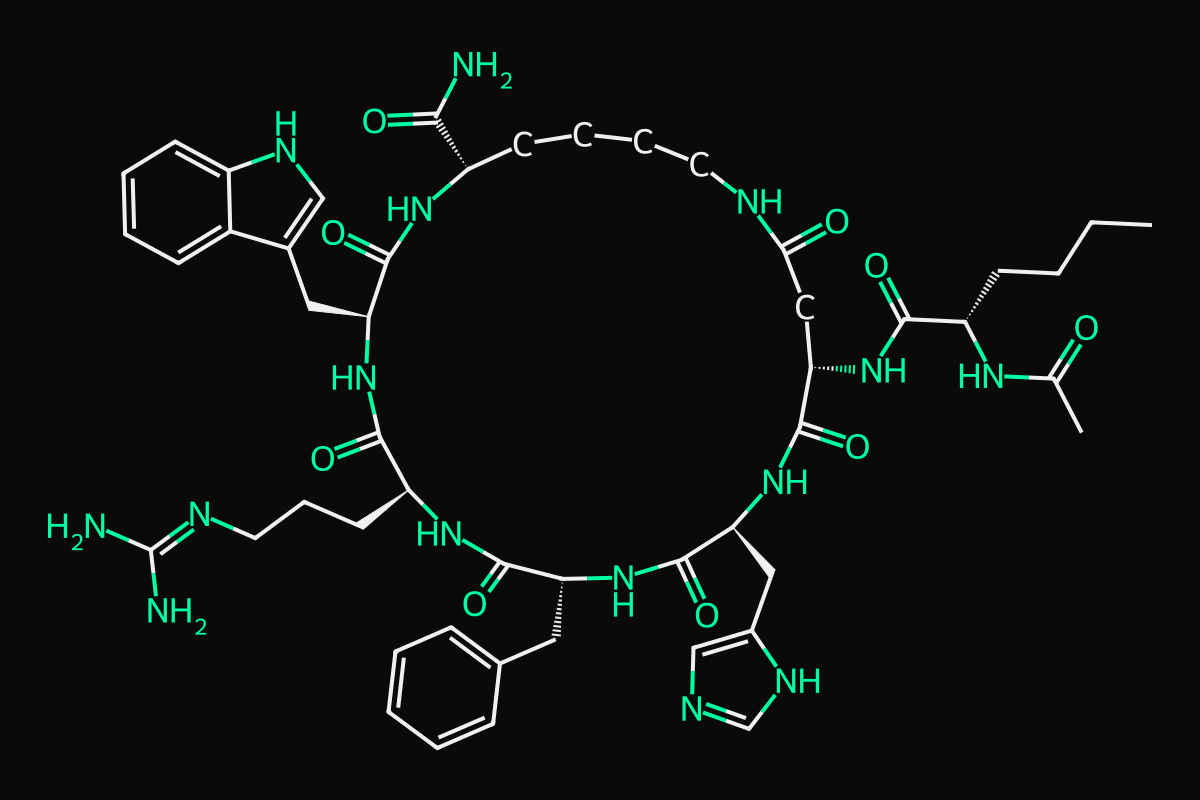
What does the research literature study?#
Because Melanotan-2 acts broadly across the melanocortin receptors, the literature uses it to study melanocortin signaling generally, and MC1R-driven melanogenesis-pathway biology in particular. Its broad receptor profile is both its research utility and the reason more selective analogs were later developed. The work is receptor pharmacology and preclinical research; this profile addresses mechanism only and makes no claim about effects in people.
How it relates to PT-141#
Melanotan-2 is the structural parent of PT-141, which is its C-terminal metabolite. The functional difference is receptor breadth: Melanotan-2 acts broadly, including at MC1R, while PT-141 shifts toward the central MC3R/MC4R subtypes. The melanocortin receptor map shows which receptor drives which pathway.
Handling and storage#
Melanotan-2 is supplied as a lyophilized powder for reconstitution. As a cyclic peptide it is reasonably stable, but handling matches standard catalog practice: the reconstitution primer covers solvent choice, and the cold-chain article covers stability once reconstituted.
Frequently asked
- What is Melanotan-2?
- Melanotan-2 (MT2) is a synthetic cyclic analog of α-melanocyte-stimulating hormone and a broad agonist across the melanocortin receptors, with notable MC1R activity. Research studies it in MC1R-signaling and melanogenesis-pathway biology. It is a laboratory research compound and is not for human use.
- Which receptors does Melanotan-2 act on?
- It is a broad melanocortin-receptor agonist, engaging several subtypes with notable activity at MC1R, the melanocyte receptor tied to the melanogenesis pathway. This broad profile distinguishes it from PT-141, which prefers the central MC3R and MC4R subtypes.
- How is Melanotan-2 related to PT-141?
- Melanotan-2 is the structural parent; PT-141 (bremelanotide) is its C-terminal metabolite. The change shifts receptor preference: Melanotan-2 acts broadly including at MC1R, while PT-141 favors the central MC3R and MC4R subtypes.
Sources and further reading#
- Hadley & Dorr, Melanotan-II — melanocortin agonist discovery and pharmacology, Peptides 2006 (PMID 16426078): review of the synthetic α-MSH analog Melanotan-II.
- MC1R and melanin synthesis in humans (PMID 16293341): study of the MC1R pathway Melanotan-2 engages.
Last updated: 2026-05-27