

On this page
GHRP-6: Compound Profile
GHRP-6 belongs to the ghrelin-receptor side of the growth-hormone secretagogue class, the same mechanism family as Ipamorelin rather than the GHRH analogs. This profile covers its identity, the receptor it engages, and its research framing. For its place in the wider class, see the GH secretagogues overview.
What is GHRP-6?#
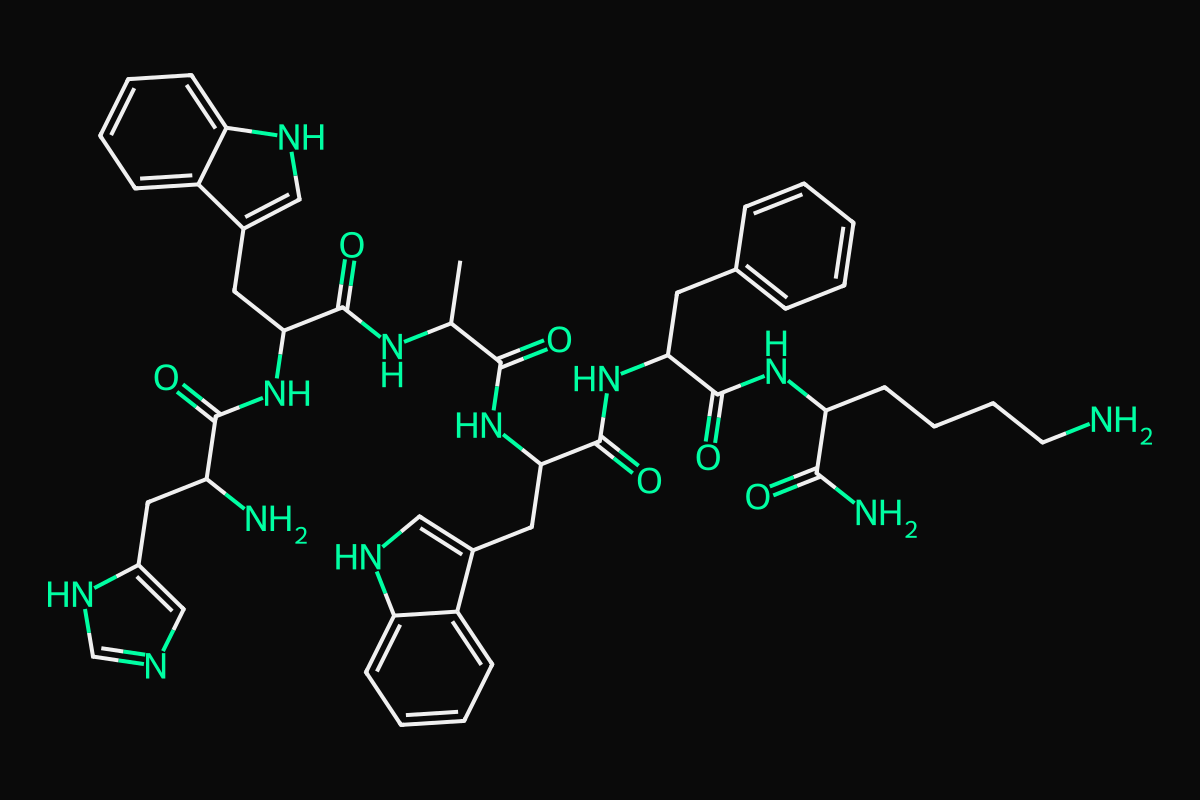
GHRP-6 is a synthetic hexapeptide of six amino acids, three of them in the D-configuration, with the sequence His-D-Trp-Ala-Trp-D-Phe-Lys-NH₂. It is one of the earliest growth-hormone-releasing peptides described and is studied as an agonist at the ghrelin / growth-hormone-secretagogue receptor (GHS-R), the same receptor the hormone ghrelin engages. Its historical significance in the literature is outsized because peptides of this series were the tool ligands used to isolate and clone that receptor before ghrelin, its endogenous ligand, was identified.
| Attribute | Value |
|---|---|
| Common name | GHRP-6 (growth-hormone-releasing peptide-6; SK&F 110679) |
| Class | Ghrelin-receptor (GHS-R) agonist; synthetic hexapeptide |
| Sequence | His-D-Trp-Ala-Trp-D-Phe-Lys-NH₂ |
| Molecular formula | C₄₆H₅₆N₁₂O₆ |
| Molecular weight | ≈ 873.0 g/mol |
| CAS number | 87616-84-0 |
| Reported target | Ghrelin / GHS receptor — UniProt Q92847, gene GHSR |
What receptor does GHRP-6 act on?#
GHRP-6 acts on the growth-hormone-secretagogue receptor (GHS-R), a G-protein-coupled receptor expressed in the pituitary and hypothalamus. This is the same receptor later shown to bind ghrelin, which is why GHRP-6 is described as a ghrelin-mimetic. The receptor was cloned and characterized as the target of the GH secretagogues by Howard and colleagues (1996), a landmark that used this class of peptide as the ligand that led back to the receptor. Its canonical annotation is catalogued under UniProt Q92847.
What does the research literature study?#
The GHRP-6 literature concentrates on GHS-R signaling and its interaction with the GHRH pathway. Work in rat primary pituitary cell culture (1989) reported that GHRP-6 and GH-releasing factor act synergistically on cyclic-AMP accumulation and GH release, a finding that established the two-pathway model the class is now organized around. Downstream signaling has also been examined at the level of intracellular messengers, including a biphasic calcium response in rat somatotrophs (1994). As across the class, this is preclinical mechanistic research and does not describe effects in humans.
How GHRP-6 sits in the secretagogue class#
The growth-hormone secretagogue class splits into two receptor families. GHRP-6 and Ipamorelin are ghrelin-receptor agonists acting on GHS-R, while CJC-1295 and Tesamorelin are GHRH analogs acting on the separate GHRH receptor. GHRP-6 is the first-generation, less selective member of the ghrelin-receptor family, whereas Ipamorelin was later characterized for its higher selectivity. The Ipamorelin compound profile covers the selective successor, and the CJC-1295 vs Ipamorelin comparison lays out the two-family split in full.
Frequently asked
- What is GHRP-6?
- GHRP-6 is a synthetic hexapeptide (His-D-Trp-Ala-Trp-D-Phe-Lys-NH₂) that acts as an agonist of the ghrelin / growth-hormone-secretagogue receptor (GHS-R). It was one of the first growth-hormone-releasing peptides described. It is a laboratory research compound and is not for human use.
- What receptor does GHRP-6 act on?
- GHRP-6 acts on the growth-hormone-secretagogue receptor (GHS-R, UniProt Q92847), the same G-protein-coupled receptor that ghrelin engages. This class of peptide was the ligand used to clone the receptor in 1996, before ghrelin itself was identified.
- How does GHRP-6 differ from Ipamorelin?
- Both act on the GHS receptor, but GHRP-6 is a first-generation, less selective hexapeptide, while Ipamorelin was characterized later for its high selectivity. Both belong to the ghrelin-receptor family and are mechanistically separate from the GHRH analogs CJC-1295 and Tesamorelin.
Sources and further reading#
- Growth hormone secretagogue receptor type 1, UniProt Q92847: canonical annotation for the GHS-R / ghrelin receptor that GHRP-6 targets.
- Howard et al., A receptor in pituitary and hypothalamus that functions in growth hormone release, Science 1996 (PMID 8688086): cloning of the GHS-R using the GH-secretagogue peptide class.
- Cheng et al., Synergistic effects of GHRP-6 on GRF-stimulated GH release and cyclic-AMP accumulation in rat pituitary cell culture, Endocrinology 1989 (PMID 2541999): primary evidence for the GHRP-6 / GHRH two-pathway interaction.
- Bresson-Bépoldin & Dufy-Barbe, GHRP-6 induces a biphasic calcium response in rat pituitary somatotrophs, Cell Calcium 1994 (PMID 8194104): downstream intracellular signaling of GHRP-6.
Last updated: 2026-08-13