

On this page
Mazdutide: Compound Profile
Mazdutide is the dual-agonist member of the metabolic peptide class, built on the oxyntomodulin backbone rather than assembled from scratch. This profile covers what it is, the two-receptor signaling mechanism the literature studies, and where it sits between the single-pathway and triple-agonist research it is grouped with. For the wider family, see the metabolic peptides overview.
What is Mazdutide?#
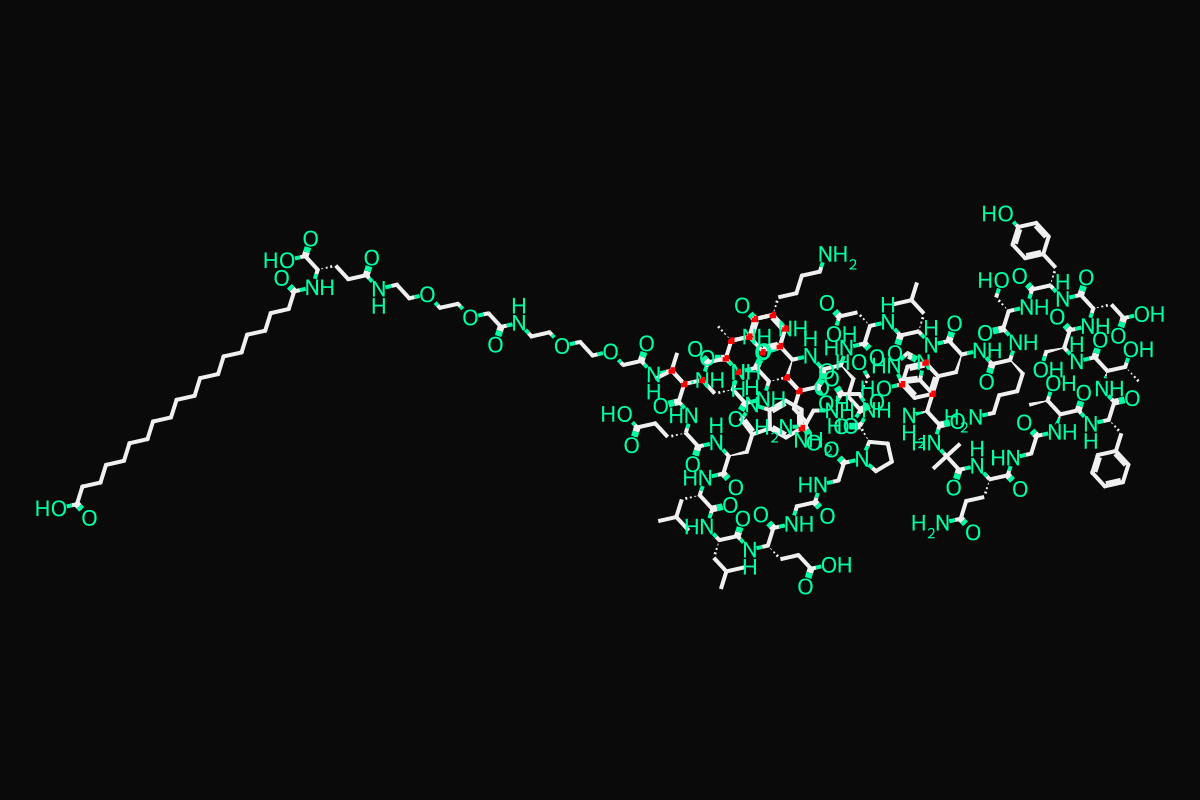
Mazdutide is a synthetic peptide derived from oxyntomodulin, one of the proglucagon-derived hormones the gut releases from the same precursor that yields glucagon and GLP-1. Oxyntomodulin is itself a natural dual ligand: it activates both the glucagon receptor and the GLP-1 receptor, though weakly at each. Mazdutide is the research designation for an engineered oxyntomodulin analog that keeps that dual-receptor character while being stabilized for laboratory work. Because it is a large lipidated peptide, its identity is anchored here on its chemical database record and its two receptor targets rather than a short sequence string.
| Attribute | Value |
|---|---|
| Common name | Mazdutide (oxyntomodulin-derived dual agonist) |
| Catalog designation | OXM-3 |
| Class | Synthetic oxyntomodulin-derived peptide; dual GLP-1 / glucagon receptor agonist |
| Receptor targets | GLP-1 receptor and glucagon receptor |
| CAS number | 2259884-03-0 |
| Molecular formula | C₂₀₇H₃₁₇N₄₅O₆₅ |
| Approximate molecular weight | ~4476 Da |
| PubChem CID | 167312357 |
| Parent hormone | Oxyntomodulin (a proglucagon-derived peptide) |
| Primary study area | Dual receptor-agonist binding and signal-transduction pharmacology |
What two-receptor mechanism does the research study?#
The research interest in Mazdutide comes from the pairing of receptors it engages. The GLP-1 receptor and the glucagon receptor are both class B1 G-protein-coupled receptors that signal primarily through Gs-coupled adenylate cyclase to raise cyclic AMP, a signaling profile reviewed in detail for the GLP-1 receptor. A single ligand that activates both receptors produces a combined signal that neither receptor generates alone, which is the phenomenon dual-agonist pharmacology is built to study. In-vitro reporter assays are the standard tool: comparable oxyntomodulin-derived dual agonists have been characterized for their relative potency at the GLP-1 and glucagon receptors, and the mechanism-of-action literature for GLP-1 and glucagon dual and triple agonists maps how the two arms of signaling differ. All of this is receptor pharmacology in preclinical and in-vitro models and does not speak to effects in people.
Why is Mazdutide built on oxyntomodulin?#
Oxyntomodulin is the natural template for balanced dual agonism. It is cleaved from proglucagon in the intestine and, unlike glucagon or GLP-1 on their own, it binds and activates both receptors, a property covered in the biology of the proglucagon-derived gut peptides. Native oxyntomodulin is short-lived and only modestly potent, so the research designs that follow it hold onto the dual-receptor signature while extending stability. Mapping where a dual agonist acts is itself an active question: a related glucagon/GLP-1 dual agonist was traced to receptor-expressing brain regions in a preclinical localization study, illustrating that the two receptors sit in different tissues and are studied separately as well as together.
Where Mazdutide sits in the metabolic peptide class#
The metabolic peptide class separates by how many receptors a compound engages. Mazdutide is a two-receptor agonist (GLP-1 and glucagon). The triple agonist GLP-3 adds a third receptor, GIP, on top of that pairing, while the amylin analog Cagrilintide works through an entirely separate amylin and calcitonin receptor system. Because the incretin agonists and the amylin analogs act on independent pathways, the literature studies them both individually and in combination. Their compound profiles (GLP-3, Cagrilintide) and the metabolic peptides overview map where each fits.
Handling and storage#
Mazdutide is supplied as a lyophilized white to off-white powder and dissolved prior to use. As a large lipidated peptide it follows standard catalog practice: the reconstitution primer covers solvent selection and avoiding aggregation, and the cold-chain article covers how stability changes once the powder is in solution. The lyophilized solid is typically kept frozen and protected from light, with repeated freeze-thaw cycles avoided.
Frequently asked
- What is Mazdutide?
- Mazdutide is a synthetic oxyntomodulin-derived peptide (CAS 2259884-03-0) studied in preclinical and in-vitro models as a dual agonist at the GLP-1 receptor and the glucagon receptor. Research examines its receptor binding and signal transduction. It is a laboratory research compound and is not for human use.
- What receptors does Mazdutide act on?
- Two: the GLP-1 receptor and the glucagon receptor. Both are class B1 G-protein-coupled receptors that signal largely through Gs-coupled adenylate cyclase and cyclic AMP. A single ligand engaging both is studied because it produces combined signaling that neither receptor generates alone.
- How is Mazdutide different from a triple agonist like GLP-3?
- Mazdutide engages two receptors, GLP-1 and glucagon. GLP-3 is this catalog's designation for a triple agonist that adds the GIP receptor to that pairing. Both are studied within incretin and glucagon-family receptor pharmacology, and the difference is the number of receptor arms engaged at once.
Sources and further reading#
- Mazdutide, PubChem CID 167312357: chemical identity record (molecular formula C₂₀₇H₃₁₇N₄₅O₆₅, molecular weight ~4476).
- GLP-1 receptor (GLP-1R) signaling: making the case for a functionally Gs protein-selective GPCR (PMID 40806371): review of GLP-1 receptor signal transduction as a class B1 Gs-coupled receptor. International Journal of Molecular Sciences 2025.
- OXM-104, a dual GLP-1 and glucagon receptor agonist (PMID 38056618): in-vitro reporter-assay characterization of an oxyntomodulin-derived dual agonist's relative receptor potency. European Journal of Pharmacology 2024.
- GLP-1 receptor agonists and dual or triple agonists — mechanism of action (PMID 40364529): review mapping the signaling arms of GLP-1, GIP, and glucagon receptor agonism. Alimentary Pharmacology & Therapeutics 2025.
- Gut peptide alterations: a narrative review (PMID 41575482): biology of the proglucagon-derived peptides, including oxyntomodulin, the parent hormone of Mazdutide. Current Obesity Reports 2026.
- A glucagon/GLP-1 dual agonist localized to receptor-expressing brain regions (PMID 41638399): preclinical localization study showing where a dual GLP-1/glucagon agonist acts at the tissue level. Molecular Metabolism 2026.
Last updated: 2026-08-17