

On this page
GLP-2: Compound Profile
GLP-2 shares a precursor protein with the incretin peptides that dominate metabolic research, yet the receptor biology the literature attributes to it is distinct: its studied signaling is confined to intestinal tissue rather than the glucose- and appetite-regulatory pathways associated with its sibling peptides. This profile covers what it is relative to that precursor, the receptor mechanism the literature attributes to it, and its research areas. For the wider family, see the metabolic peptides overview.
What is GLP-2?#
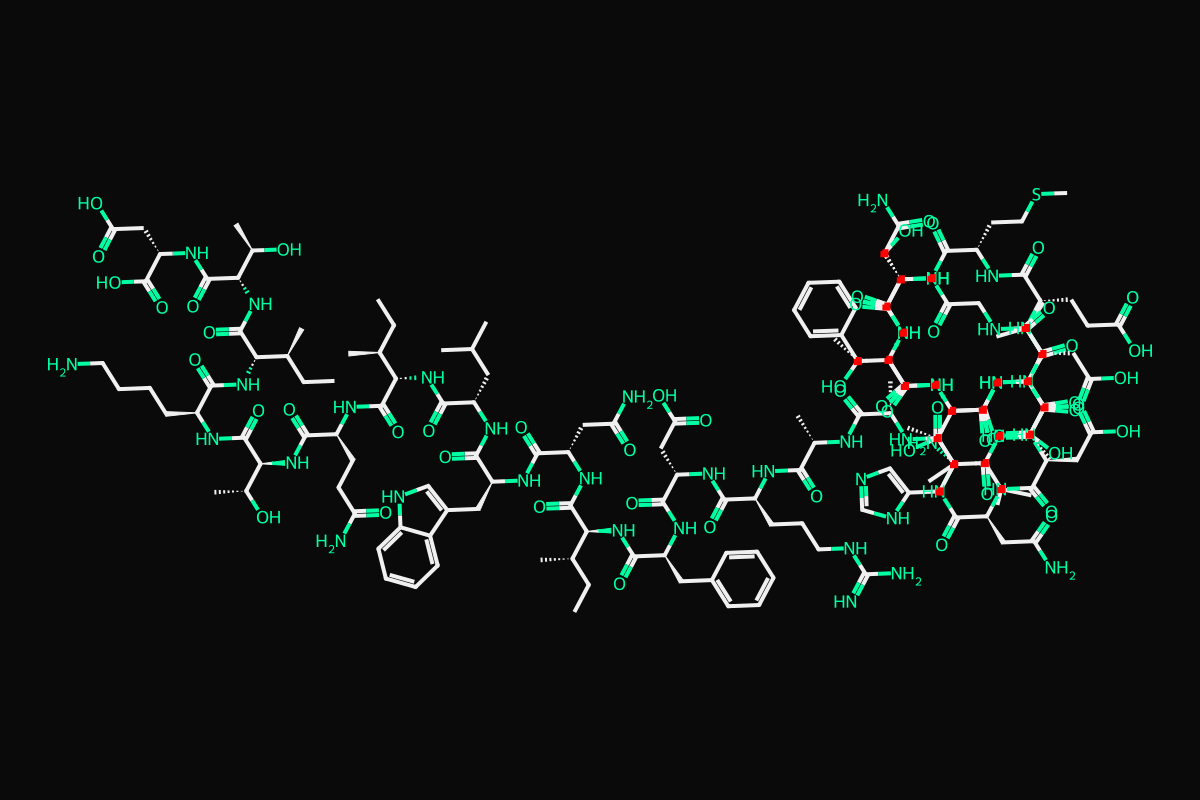
GLP-2 (glucagon-like peptide-2) is a 33-amino-acid peptide released when the proglucagon precursor is post-translationally cleaved in intestinal enteroendocrine L cells. The same precursor, encoded by the GCG gene, yields glucagon and GLP-1; GLP-2 sits carboxy-terminal to GLP-1 in the sequence. Because the name refers to this specific proglucagon-derived fragment, the reliable identity anchor is the precursor protein and its GCG gene rather than any single supplier-quoted figure.
| Attribute | Value |
|---|---|
| Common name | GLP-2 (glucagon-like peptide-2) |
| Peptide class | Proglucagon-derived peptide (intestinotrophic factor) |
| Length | 33 amino acids |
| Precursor protein | Proglucagon — UniProt P01275, gene GCG |
| Co-released peptides | Glucagon and GLP-1 (same precursor) |
| Reported receptor | GLP-2 receptor (GLP2R) — UniProt O95838 |
| Receptor family | Class B G-protein-coupled receptor |
| Primary tissue studied | Small-intestinal epithelium |
How does the GLP-2 receptor mechanism work?#
The literature attributes GLP-2 action to a single G-protein-coupled receptor, GLP-2R, cloned and characterized as a prototypic receptor for the intestinotrophic factor. GLP2R is a class B GPCR most closely related to the glucagon and GLP-1 receptors, and its expression is concentrated in the gastrointestinal tract. This tissue-restricted distribution is why the studied biology of GLP-2 is largely confined to the gut rather than the systemic glucose handling associated with its sibling peptide GLP-1.
What does the research literature study?#
GLP-2 draws research interest for its role as an intestinotrophic mediator: in animal and cell models it is studied for crypt cell proliferation, villus architecture, and epithelial barrier parameters in the small intestine. Broader physiology and pharmacology reviews catalog its studied associations with gut motility, mucosal surface area, and nutrient-transport pathways. As across this class, the work is preclinical, conducted in cell culture and animal models, and does not speak to effects in people.
Where GLP-2 sits in the metabolic-peptide class#
GLP-2 and the incretin peptides share the proglucagon precursor, which is why they are grouped in the same research family, but their receptors and studied tissues diverge. The incretin arm engages the GLP-1 and GIP receptors studied in glucose-dependent insulin-signaling and appetite-signaling pathways; GLP-2 engages its own gut-restricted receptor. The incretin triple agonism explainer develops the receptor mechanics on the incretin side of the family, and the metabolic peptides overview places both within the class.
Frequently asked
- What is GLP-2?
- GLP-2 is a 33-amino-acid peptide cleaved from the proglucagon precursor (UniProt P01275, gene GCG) and secreted by intestinal L cells. Research studies it as an intestinotrophic factor acting on epithelial growth in the small intestine. It is a laboratory research compound and is not for human use.
- How is GLP-2 related to GLP-1?
- Both are derived from the same proglucagon precursor and share a gene (GCG), but they act through different receptors on different tissues. GLP-1 engages the GLP-1 receptor studied in glucose- and appetite-signaling research, while GLP-2 engages the gut-restricted GLP-2 receptor (UniProt O95838) studied for intestinal epithelial biology.
- What does the research on GLP-2 study?
- The literature focuses on intestinal epithelial growth: crypt cell proliferation, villus architecture, mucosal surface area, and barrier parameters, all transduced through the GLP-2 receptor. This work is preclinical, conducted in cell culture and animal models, and does not demonstrate effects in humans.
Sources and further reading#
- Proglucagon, UniProt P01275: canonical sequence and annotation for the precursor protein that yields GLP-2, GLP-1, and glucagon (gene GCG).
- Glucagon-like peptide 2 receptor, UniProt O95838: annotation for the class B GPCR (GLP2R) that transduces GLP-2 action.
- Prototypic G-protein-coupled receptor for the intestinotrophic factor glucagon-like peptide 2 (PMID 9990065): primary characterization of the GLP-2 receptor.
- Glucagon-like peptide 2 (GLP-2), an intestinotrophic mediator (PMID 14965320): review of the intestinal epithelial biology studied for GLP-2.
- Physiology and pharmacology of the enteroendocrine hormone glucagon-like peptide-2 (PMID 24161075): comprehensive review of GLP-2 secretion, receptor signaling, and studied gut actions.
Last updated: 2026-08-13