

On this page
Cartalax: Compound Profile
Cartalax sits at the short end of the peptide spectrum: three amino acids, yet it recurs across a specific corner of the literature that asks how brief sequences influence gene expression inside connective-tissue cells rather than binding a classical surface receptor. This profile covers what it is, the chondrocyte and connective-tissue signaling the research attributes to it, and where it sits among the other ultra-short bioregulator peptides, including its close relatives Epitalon and Pinealon.
What is Cartalax?#
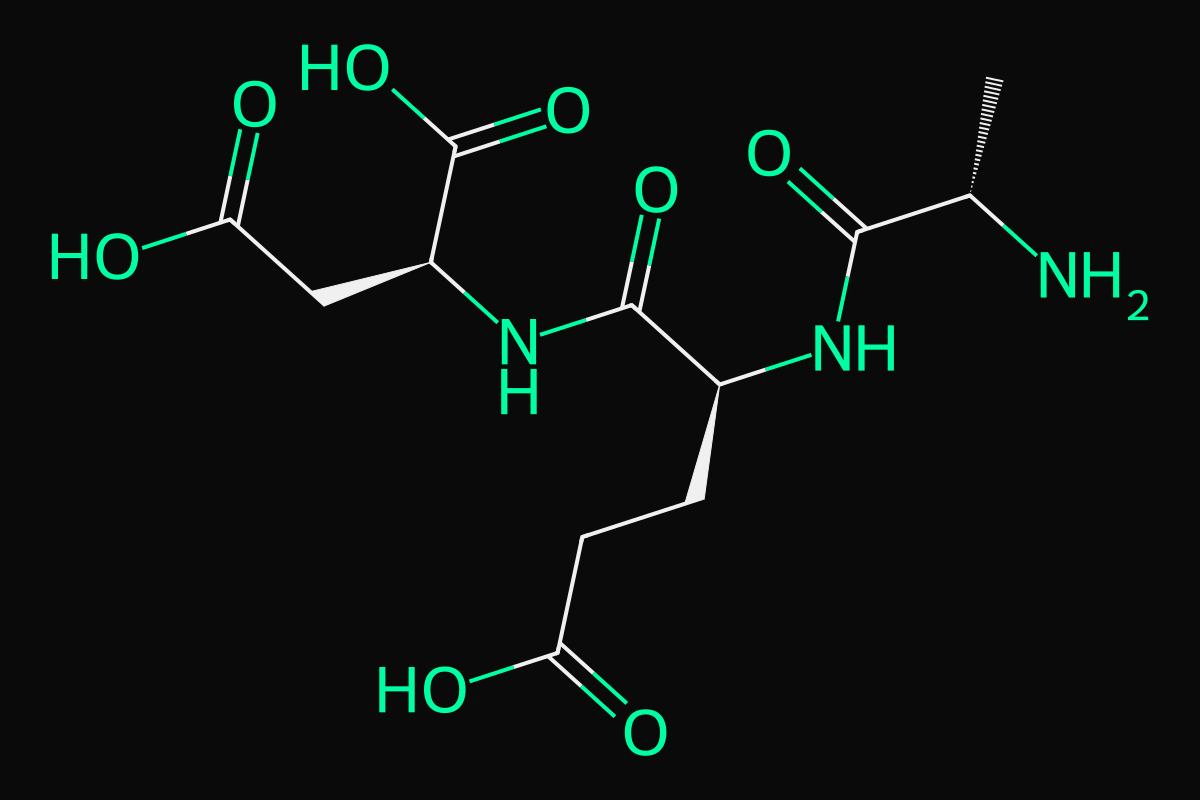
Cartalax is a synthetic linear tripeptide with the sequence Ala-Glu-Asp, written AED in single-letter code, which is why the wider literature often refers to it as the AED peptide. It was developed within the Russian program of ultra-short peptide bioregulators associated with Vladimir Khavinson, the same body of work that produced the tetrapeptide Epitalon and the tripeptide Pinealon. Where a full protein runs to hundreds of residues, Cartalax is short enough to be synthesized and characterized precisely, and its identity is captured under a single record in the standard chemical databases. The name refers to the tissue context researchers associated it with, not an established function in any organism.
| Attribute | Value |
|---|---|
| Common name | Cartalax (AED peptide) |
| Class | Synthetic linear tripeptide (ultra-short bioregulator) |
| Sequence | Ala-Glu-Asp (AED) |
| Molecular formula | C₁₂H₁₉N₃O₈ |
| Approximate molecular weight | ~333.29 g/mol |
| PubChem CID | 87815447 |
| Related bioregulators | Epitalon (Ala-Glu-Asp-Gly), Pinealon (Glu-Asp-Arg) |
| Primary study area | Connective-tissue and chondrocyte gene-expression signaling research |
What does the research literature study?#
The Cartalax literature concentrates on a narrow question: how a three-residue sequence might influence gene expression inside connective-tissue cells rather than acting at a surface receptor. Much of the surrounding work sits within the broader account of how short peptides regulate transcription, summarized in a systematic review of peptide regulation of gene expression that catalogs the ultra-short bioregulators and the intracellular targets attributed to them. Closer to the tissue context, preclinical studies have examined short peptides in chondrogenic stem-cell differentiation models and in chondrocyte cultures modeling the aging-associated secretory phenotype, where the reported readouts are expression-level changes in cartilage-related markers. A companion cell-culture study reports that such peptides attenuate the forming of that secretory phenotype under replicative-aging conditions. How ultra-short peptides reach an intracellular compartment at all is itself an open methodological question, addressed in work on peptide transport via POT and LAT carriers. All of this is preclinical, cell-culture and model-system research, and none of it speaks to effects in people.
Where Cartalax sits among the bioregulator peptides#
The ultra-short bioregulator peptides are grouped less by a shared receptor and more by a shared design idea: sequences of two to four amino acids studied for intracellular, gene-expression-level signaling rather than classical surface-receptor agonism. Cartalax is one of the tripeptide members of this group, sharing the Ala-Glu-Asp core with the tetrapeptide Epitalon (Ala-Glu-Asp-Gly), which differs only by a terminal glycine. Epitalon carries its own compound profile, as does the neuronal-signaling tripeptide Pinealon; reading Cartalax alongside them is the natural way to place its short sequence within the family, since the three are frequently studied under the same research framework.
Handling and storage#
Cartalax is supplied as a white lyophilized powder and dissolved prior to use. As a short, highly polar linear tripeptide, it is handled the same way as the rest of the short-peptide catalog: the reconstitution primer covers solvent selection and avoiding aggregation, while the cold-chain article covers how stability shifts once the powder is in solution and why freeze-thaw cycling is minimized.
Frequently asked
- What is Cartalax?
- Cartalax is a synthetic linear tripeptide with the sequence Ala-Glu-Asp, also known as the AED peptide. It comes from the Russian ultra-short bioregulator peptide program and is studied in preclinical models of connective-tissue and chondrocyte gene-expression signaling. It is a laboratory research compound and is not for human use.
- What does the research on Cartalax study?
- The literature examines how the three-residue AED sequence relates to gene expression inside connective-tissue and cartilage cells, using chondrogenic differentiation models and chondrocyte cultures that measure expression-level changes rather than a classical receptor response. This work is preclinical and cell-culture based and does not demonstrate outcomes in people.
- How is Cartalax related to Epitalon?
- Cartalax is the Ala-Glu-Asp tripeptide, and Epitalon is the Ala-Glu-Asp-Gly tetrapeptide, so the two share the same three-residue core and differ only by a terminal glycine. Both come from the same ultra-short bioregulator research lineage and are frequently studied under a shared framework, which makes Epitalon the natural companion reference.
Sources and further reading#
- Peptide Regulation of Gene Expression: A Systematic Review (PMID 34834147): a systematic review cataloging the ultra-short peptide bioregulators and the intracellular, gene-expression-level targets attributed to them. Molecules 2021.
- Peptide Regulation of Chondrogenic Stem Cell Differentiation (PMID 37176122): a preclinical study of short peptides in chondrogenic differentiation models relevant to the connective-tissue context. International Journal of Molecular Sciences 2023.
- Chondrocytes secretory phenotype associated with aging: role in the pathogenesis of osteoarthritis and prospects for peptide bioregulation (PMID 37782637): a cell-model review placing short-peptide bioregulation within cartilage-cell aging research. Advances in Gerontology 2023.
- Peptides prevent the forming of secretory phenotype of chondrocytes associated with the aging (PMID 37356100): a chondrocyte cell-culture study reporting expression-level effects under replicative-aging conditions. Advances in Gerontology 2023.
- Transport of Biologically Active Ultrashort Peptides Using POT and LAT Carriers (PMID 35887081): a study of the carrier mechanisms by which ultra-short peptides such as AED-type sequences reach intracellular compartments. International Journal of Molecular Sciences 2022.
- Cartalax, PubChem CID 87815447: chemical identity record for the Ala-Glu-Asp tripeptide (molecular formula and structure).
Last updated: 2026-08-17