

On this page
Pinealon: Compound Profile
Pinealon sits at the short end of the peptide spectrum: just three amino acids, yet it appears often in the neuroscience literature on how brief peptide sequences influence what happens inside a neuron rather than at a surface receptor. This profile covers what it is, the oxidative-stress and gene-expression signaling the research attributes to it, and where it sits among the other ultra-short bioregulator peptides such as its close relative Epitalon.
What is Pinealon?#
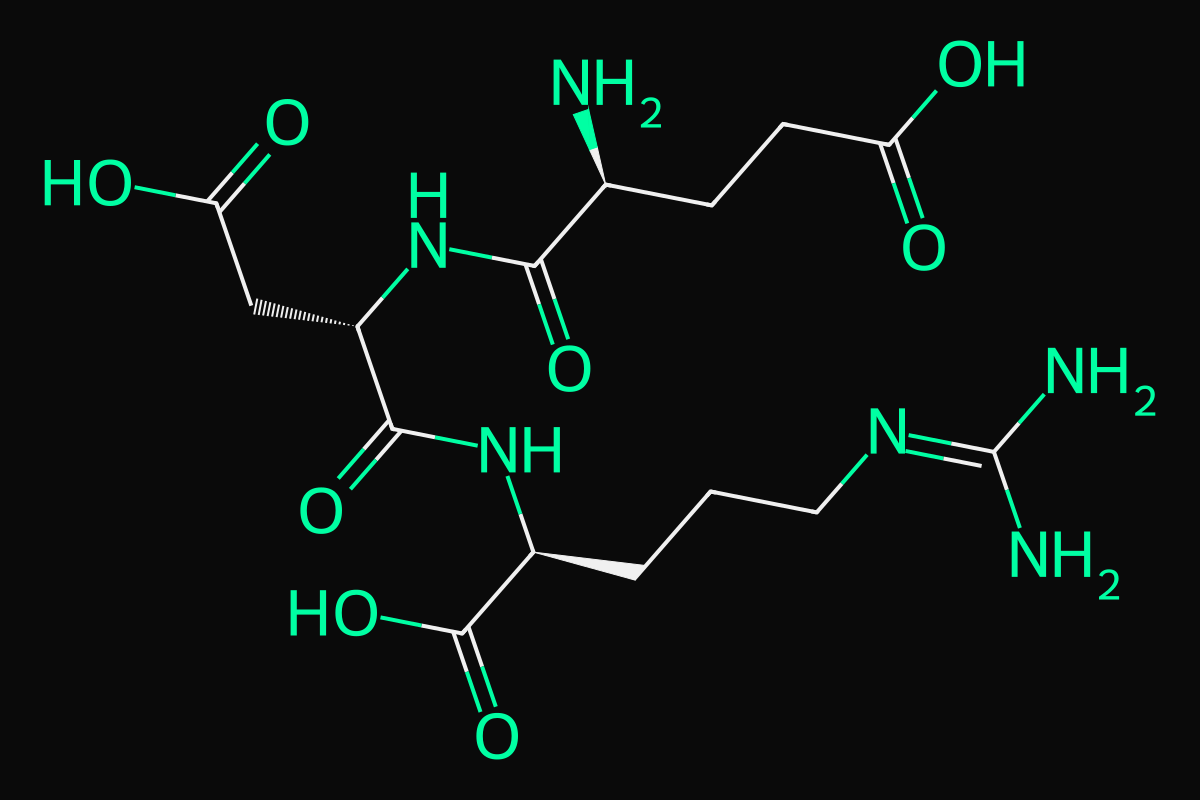
Pinealon is a synthetic linear tripeptide with the sequence Glu-Asp-Arg, more compactly written as EDR in single-letter code, which is why the wider literature usually calls it the "EDR peptide." It was developed within the Russian program of ultra-short peptide bioregulators associated with Vladimir Khavinson, the same line of work that produced the tetrapeptide Epitalon. Where a full protein is hundreds of residues long, Pinealon is short enough to be characterized precisely, and its identity is captured in the standard chemical databases under a single compound record. The name refers to the research program it came from, not to an established function in any organism.
| Attribute | Value |
|---|---|
| Common name | Pinealon (EDR peptide) |
| Class | Synthetic linear tripeptide (ultra-short bioregulator) |
| Sequence | Glu-Asp-Arg (EDR); H-Glu-Asp-Arg-OH |
| Molecular formula | C₁₅H₂₆N₆O₈ |
| Approximate molecular weight | ~418.4 Da |
| PubChem CID | 10273502 |
| Related bioregulator | Epitalon (Ala-Glu-Asp-Gly) |
| Primary study area | Neuronal oxidative-stress and gene-expression signaling research |
What does the research literature study?#
The Pinealon literature is centered on two related preclinical questions: how the peptide behaves under oxidative stress in cultured cells, and how such a short sequence could reach and influence gene expression at all. A cell-viability study reported that Pinealon suppressed free-radical levels and was associated with proliferative activity in a hydrogen-peroxide oxidative-stress model, framing it as a modulator of the redox environment rather than a signaling agonist. The proposed route to gene expression has its own mechanistic literature: a molecular-review paper on the EDR peptide lays out how the tripeptide is hypothesized to regulate gene expression and protein synthesis, and a separate biophysical study examined how mono- and divalent ions govern the direct interaction between the Glu-Asp-Arg peptide and DNA. All of this is preclinical mechanism work and does not speak to effects in people.
A second cluster of work places Pinealon in animal neurology models. Rodent studies have examined the peptide in a prenatal hyperhomocysteinemia model and, alongside the peptide preparation Cortexin, in behavioral and neurochemical models in aged rats under hypoxia and hypothermia. More recent cellular work has looked at short peptides in fibroblast-derived induced neurons, keeping the focus on gene-expression and cellular signaling readouts. Across these papers the compound is studied as a research tool for probing neuronal signaling pathways, not as a defined receptor ligand.
Where Pinealon sits among the bioregulator peptides#
The ultra-short bioregulator peptides are grouped less by a shared receptor and more by a shared design idea: sequences of two to four amino acids studied for intracellular, gene-expression-level effects rather than classical surface-receptor agonism. Pinealon is the tripeptide member of this group. Its closest relative in the catalog is the tetrapeptide Epitalon, which carries its own compound profile and comes from the same research lineage. The two are frequently studied side by side, which makes Epitalon the natural companion reference when reading the Pinealon literature.
Handling and storage#
Pinealon is supplied as a white lyophilized powder and dissolved prior to use. As a short, highly polar linear peptide it is handled the same way as the rest of the catalog: the reconstitution primer covers solvent selection and avoiding aggregation, while the cold-chain article covers how stability changes once the powder is in solution. The lyophilized solid is best kept cold and protected from light, with freeze-thaw cycles on any reconstituted stock kept to a minimum.
Frequently asked
- What is Pinealon?
- Pinealon is a synthetic linear tripeptide with the sequence Glu-Asp-Arg, also known as the EDR peptide. It comes from the Russian ultra-short bioregulator peptide program and is studied in preclinical models of neuronal oxidative-stress and gene-expression signaling. It is a laboratory research compound and is not for human use.
- What does the research on Pinealon study?
- The literature focuses on how the tripeptide behaves under oxidative stress in cultured cells and on the hypothesized mechanism by which so short a sequence could reach DNA and influence gene expression. Rodent neurology models add context. This work is preclinical and does not demonstrate outcomes in people.
- How is Pinealon related to Epitalon?
- Both are ultra-short bioregulator peptides from the same research lineage. Pinealon is the tripeptide Glu-Asp-Arg, while Epitalon is the tetrapeptide Ala-Glu-Asp-Gly. They are frequently studied side by side in the cellular-aging and gene-expression literature, which is why Epitalon is the natural companion reference.
Sources and further reading#
- Pinealon increases cell viability by suppression of free radical levels and activating proliferative processes (PMID 21978084): a cell-culture oxidative-stress study reporting free-radical suppression and proliferative activity. Rejuvenation Research 2011.
- EDR Peptide: Possible Mechanism of Gene Expression and Protein Synthesis Regulation (PMID 33396470): a molecular review of the proposed gene-expression and protein-synthesis mechanism of the Glu-Asp-Arg peptide. Molecules 2020.
- Role of Mono- and Divalent Ions in Peptide Glu-Asp-Arg-DNA Interaction (PMID 30762356): a biophysical study of how ionic conditions govern the direct EDR-peptide-DNA interaction. The Journal of Physical Chemistry B 2019.
- Pinealon protects the rat offspring from prenatal hyperhomocysteinemia (PMID 22567179): a rodent developmental-neurology model examining the tripeptide. International Journal of Clinical and Experimental Medicine 2012.
- Pinealon and Cortexin influence on behavior and neurochemical processes in 18-month aged rats within hypoxia and hypothermia (PMID 28509493): a rodent behavioral and neurochemical model under hypoxic and hypothermic stress. 2015.
- Short Peptides Protect Fibroblast-Derived Induced Neurons from Age-Related Changes (PMID 39518916): a cellular study of short peptides, including EDR, in induced-neuron models. International Journal of Molecular Sciences 2024.
- Pinealon, PubChem CID 10273502: chemical identity record for the Glu-Asp-Arg tripeptide (molecular formula and structure).
Last updated: 2026-08-17