

On this page
AHK-Cu: Compound Profile
AHK-Cu belongs to the small family of histidine-anchored copper tripeptides studied within the tissue-repair class, alongside the better-characterized GHK-Cu. This profile covers its identity relative to that parent tripeptide, the copper-delivery mechanism the literature attributes to it, and its research areas. For its place in the wider class, see the tissue-repair peptides overview.
What is AHK-Cu?#
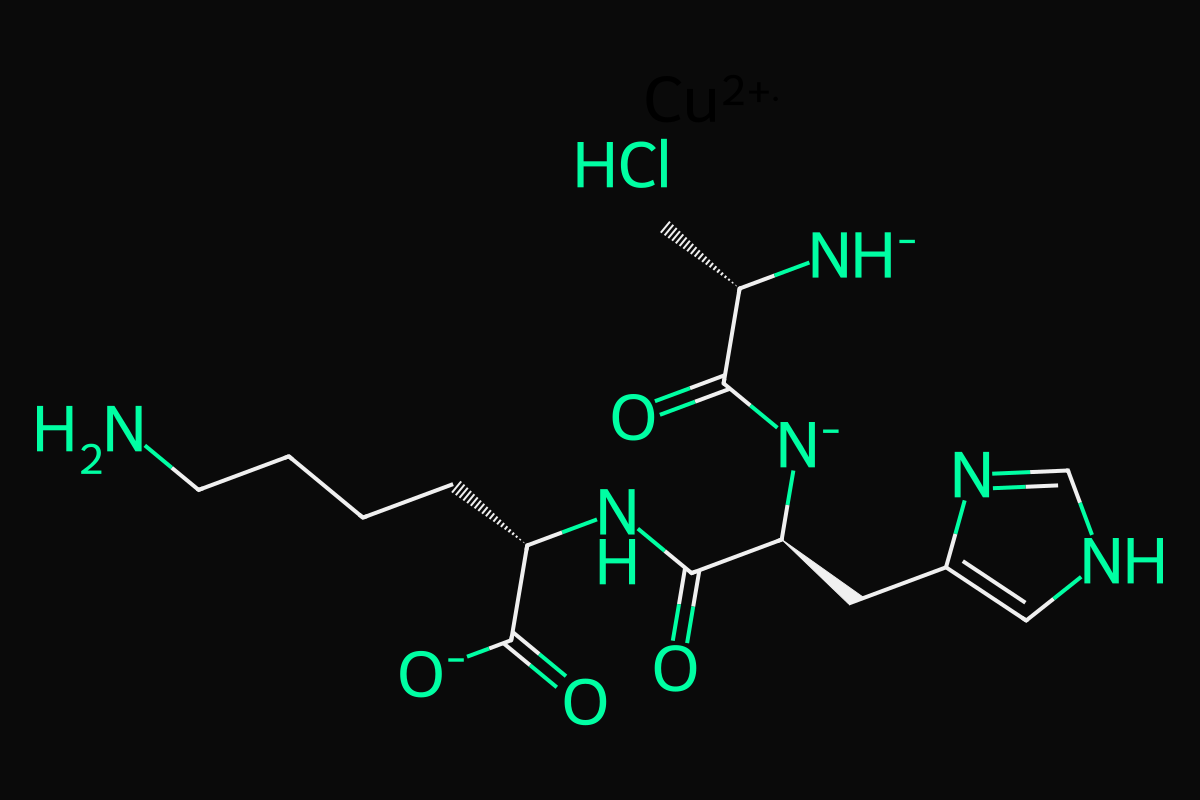
AHK-Cu is the copper(II) complex of AHK, a tripeptide of L-alanine, L-histidine, and L-lysine. Structurally it is the alanine analogue of GHK, the difference being a single N-terminal residue: where GHK opens with glycine, AHK opens with alanine, adding one methyl group to the backbone. The histidine imidazole nitrogen, the deprotonated amide nitrogen, and the free amino terminus together form the square-planar copper-coordination site common to this tripeptide family. Because of that shared chelation geometry, AHK binds copper(II) in a 1:1 ratio and functions as a copper-delivery molecule, the same way its glycine counterpart does. The lysine side chain contributes the positively charged residue that the literature associates with membrane and matrix affinity. Its reported activity in the literature is copper-dependent rather than a property of the bare peptide, which is why the complex, and not the free tripeptide, is the studied form.
| Attribute | Value |
|---|---|
| Common name | AHK-Cu (copper tripeptide) |
| Class | Copper(II) complex of a histidine-anchored tripeptide |
| Peptide sequence | L-alanyl-L-histidyl-L-lysine (Ala-His-Lys / AHK) |
| Tripeptide formula | C₁₅H₂₆N₆O₄ (free AHK) — PubChem CID 7408502 |
| Tripeptide molecular weight | ≈ 354.4 g/mol (free AHK) |
| Copper binding | 1:1 complex with Cu(II) at the His/N-terminal site |
| Closest relative | GHK-Cu (glycine in place of alanine at the N-terminus) |
What does the research literature study?#
The published work on AHK-Cu is thinner than the large GHK-Cu literature, and much of what circulates on the specific alanine analogue is patent rather than peer-reviewed. That matters for anyone surveying the family: a rigorous survey has to lean on the copper-transport chemistry the tripeptides share and on the far deeper GHK-Cu record, rather than on a large primary corpus for AHK-Cu itself. The peer-reviewed anchor for this family is copper transport. A comparative study of the skin-penetration ability of copper complexes with peptides examines how tripeptide chelation governs copper movement across the stratum corneum, the property these complexes are studied for, and treats the peptide as the vehicle that carries the metal rather than the active species on its own. The most direct primary work on the alanine analogue is follicular: a study of AHK-Cu on human hair follicles ex vivo and cultured dermal papilla cells reports that the complex, at picomolar to nanomolar concentrations, altered dermal-papilla-cell proliferation and apoptosis markers (a raised Bcl-2/Bax ratio and reduced cleaved caspase-3), which is why AHK-Cu is most often referenced in follicular models. The broader mechanistic frame comes from the GHK-Cu review literature, where the copper tripeptide is described as a modulator of multiple cellular pathways spanning collagen synthesis, extracellular-matrix remodeling, and antioxidant signaling, whose reported effects depend on the redox-active copper ion. Since AHK shares the coordination site that binds that ion, its research interest sits in the same copper-delivery frame. As across the class, this is preclinical research and does not speak to human effects.
How does AHK-Cu differ from GHK-Cu?#
The two peptides differ by a single N-terminal residue. Both share the His-Lys copper-coordination architecture, so both act as copper carriers, and the literature groups them as members of the same histidine-anchored tripeptide family. GHK-Cu is the far more studied of the pair, having been isolated from human plasma in 1973 and characterized across collagen synthesis, matrix remodeling, and gene-expression research; AHK-Cu is the less-documented alanine analogue, most often referenced in follicular and skin-penetration contexts. For the deeply characterized member of the family, see the GHK-Cu compound profile, and for the class as a whole the tissue-repair cornerstone. Nexara catalogs the sibling copper tripeptide GHK-Cu (50mg) for laboratory research.
Handling and storage#
Copper tripeptides ship as a lyophilized powder — often visibly blue when the copper complex is present — and are dissolved before use. The reconstitution primer covers solvent selection and aggregation, while the cold-chain article covers how storage stability shifts once the material is in solution.
Frequently asked
- What is AHK-Cu?
- AHK-Cu is the copper(II) complex of the tripeptide L-alanyl-L-histidyl-L-lysine (AHK), a close structural relative of GHK-Cu. It functions as a copper-delivery peptide, and research references it in skin-penetration and follicular contexts. It is a laboratory research compound and is not for human use.
- How is AHK-Cu different from GHK-Cu?
- They differ by a single N-terminal amino acid: GHK begins with glycine, AHK with alanine. Both carry the same His-Lys copper-coordination site and act as copper carriers. GHK-Cu is far more studied, while AHK-Cu is the less-documented alanine analogue.
- What does the research on AHK-Cu study?
- The peer-reviewed anchor for this tripeptide family is copper transport across the skin barrier, studied through stratum-corneum penetration models. Much of the material specific to the alanine analogue is patent rather than peer-reviewed literature, and all of it is preclinical, not a demonstration of human effects.
Sources and further reading#
- L-Alanyl-L-histidyl-L-lysine, PubChem CID 7408502: identity, formula (C₁₅H₂₆N₆O₄), and structure for the AHK tripeptide.
- Skin penetration ability of copper complexes with peptides (PMID 18350235): comparative study of copper transport across the stratum corneum for copper tripeptide complexes. Journal of Cosmetic Science 2008.
- The effect of tripeptide-copper complex on human hair growth in vitro (PMID 17703734): primary study of AHK-Cu on human hair follicles ex vivo and cultured dermal papilla cells. Archives of Pharmaceutical Research 2007.
- GHK Peptide as a Natural Modulator of Multiple Cellular Pathways in Skin Regeneration (PMC4508379): mechanistic review of the closely related copper tripeptide GHK-Cu. BioMed Research International 2015.
Last updated: 2026-08-13