

On this page
Adipotide: Compound Profile
Adipotide is the outlier of the metabolic peptide class. It is not a receptor agonist that signals on the incretin or amylin systems but a targeted delivery construct that acts on the blood supply of fat tissue. This profile covers what it is, the vascular-homing mechanism the literature attributes to it, and its research areas. For the wider class, see the metabolic peptides overview.
What is Adipotide?#
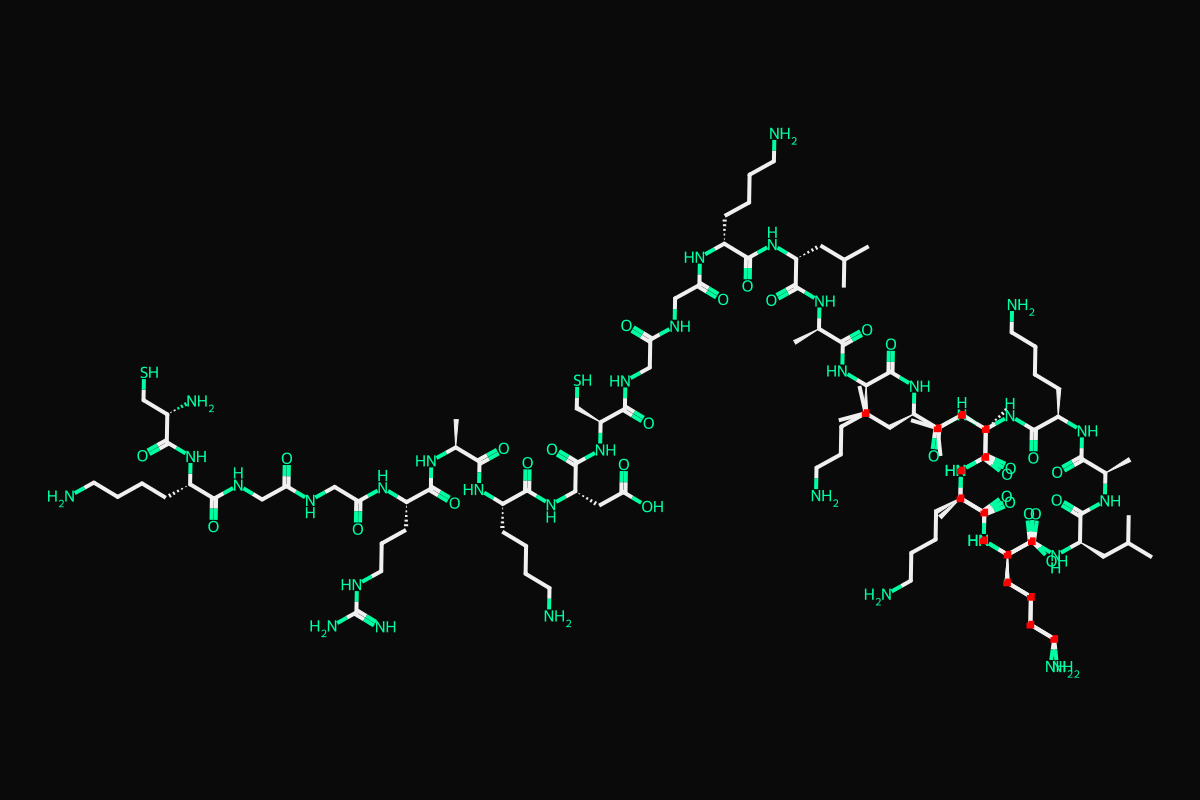
Adipotide, also called FTPP (fat-targeting proapoptotic peptide) or prohibitin-targeting peptide 1, is a bifunctional peptidomimetic first described by Kolonin and colleagues in 2004. It joins two functional domains through a short linker: a cyclic homing motif, CKGGRAKDC, that binds a receptor complex on the endothelium of white adipose tissue, and a D-enantiomer pro-apoptotic segment, (D)(KLAKLAK)₂, that disrupts mitochondrial membranes once the construct is internalized. Because it is a designed chimera rather than a natural sequence, the reliable identity anchor is its verified molecular target, the prohibitin receptor complex, rather than a single quoted mass.
| Attribute | Value |
|---|---|
| Common name | Adipotide (FTPP; prohibitin-targeting peptide 1) |
| Peptide class | Two-domain targeting peptidomimetic (homing motif + pro-apoptotic segment) |
| Homing domain | Cyclic CKGGRAKDC motif |
| Effector domain | (D)(KLAKLAK)₂ pro-apoptotic segment |
| Primary receptor | Prohibitin (PHB1) — UniProt P35232, gene PHB1 |
| Co-receptor | Annexin A2 — UniProt P07355 |
| Reported target tissue | Endothelium of white adipose-tissue microvasculature |
How does the targeting mechanism work?#
The mechanism is a two-step "address-then-effect" design. The CKGGRAKDC domain acts as the address: it was isolated by in vivo phage display as a motif that homes selectively to the vasculature of white fat, where the prohibitin–annexin A2 complex is unusually abundant on the endothelial surface. Once bound and internalized, the (D)(KLAKLAK)₂ effector domain engages the mitochondrial membrane of that endothelial cell. The D-amino-acid backbone resists peptidase cleavage, so the effector reaches its target intact. In the original Nature Medicine report, this construct was studied as a way to probe the dependence of adipose depots on their microvascular support.
What does the research literature study?#
The literature is anchored by two primary papers. The 2004 Kolonin study characterized the homing motif and its action on adipose-tissue vasculature in rodent models. A 2011 study by Barnhart and colleagues extended the work to spontaneously obese rhesus monkeys, using MRI and DEXA imaging to quantify changes in adipose depots and reporting a dose-dependent, reversible renal signal tied to the pro-apoptotic domain. As across the class, this is preclinical research in animal models and does not speak to human effects; reported clinical development was discontinued.
Where Adipotide sits in the metabolic class#
Adipotide shares only the broad metabolic-research heading with the rest of the class. GLP-3 and Cagrilintide are receptor agonists that signal through hormone pathways; AOD9604 is a hormone fragment. Adipotide is none of these — it is a targeted delivery construct whose action depends on a tissue-address motif and a mitochondrial effector, not on receptor signaling. The metabolic peptides overview lays out how these separate mechanisms group under one research heading.
Handling and storage#
Two-domain peptidomimetics are supplied as lyophilized solids and dissolved before use. For the practical details, the reconstitution primer covers solvent selection and aggregation, while the cold-chain article covers how stability changes once the powder is in solution.
Frequently asked
- What is Adipotide?
- Adipotide (FTPP) is a two-domain peptidomimetic that pairs a cyclic CKGGRAKDC homing motif with a (D)(KLAKLAK)₂ pro-apoptotic segment. The homing motif binds the prohibitin receptor complex on adipose-tissue endothelium. It is a laboratory research compound and is not for human use.
- What is Adipotide's molecular target?
- The homing domain targets a receptor complex on the endothelium of white adipose-tissue vasculature, centered on prohibitin (UniProt P35232) with annexin A2 (UniProt P07355) as a co-receptor. This target was identified by in vivo phage display in the 2004 Nature Medicine study that first described the peptide.
- What does the research on Adipotide study?
- The literature centers on two preclinical papers — a 2004 rodent study (PMID 15133506) and a 2011 rhesus-monkey study (PMID 22072637) — examining the dependence of adipose depots on their microvascular supply. This work is conducted in animal models and does not demonstrate effects in humans; reported clinical development was discontinued.
Sources and further reading#
- Kolonin et al., targeted ablation of adipose-tissue vasculature (PMID 15133506): the primary Nature Medicine paper that isolated the CKGGRAKDC homing motif and described the two-domain construct. Nature Medicine 2004. doi:10.1038/nm1048.
- Barnhart et al., a peptidomimetic targeting white adipose vasculature in obese rhesus monkeys (PMID 22072637 · PMC3666164): the non-human-primate study extending the construct, with MRI/DEXA imaging quantification and a reversible renal signal. Science Translational Medicine 2011. doi:10.1126/scitranslmed.3002621.
- Prohibitin (PHB1), UniProt P35232: canonical annotation for the receptor at the center of the homing target complex.
- Annexin A2, UniProt P07355: canonical annotation for the reported co-receptor of the homing motif.
Last updated: 2026-08-13